

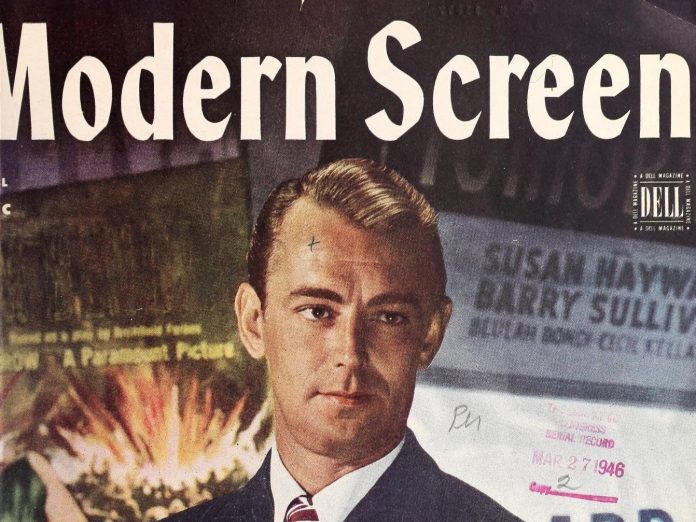
Alan Ladd on cover of “Modern Screen”, April 1946. Cropped.
During the Second World War, many in Hollywood signed up to serve their country in the Office of Strategic Services (OSS) — America’s first intelligence agency and the forerunner of the Central Intelligence Agency (CIA). This included prolific Oscar-winning filmmaker John Ford and legendary Disney camera effects artist Bob Broughton. Together, they created OSS training films and documented OSS activities in the field, pioneering the use of film in intelligence for generations to come.
At that time, Hollywood studios were prohibited from mentioning OSS in films due to secrecy. Screenwriters did their best to keep those three little letters out of wartime scripts. However, many Hollywood icons were stepping up and supporting the OSS. Hollywood heartthrob and OSS veteran, Sterling Hayden, was one of them.
Hollywood also had a role in shaping the image of the enemy. For instance, Walt Disney’s cartoon Der Fuehrer’s Face (December 1942) asked audiences to sing “Heil” to Hitler’s face. This was part of the wartime propaganda effort to mock and belittle the enemy.
However, some government officials believed that the enemy should be portrayed as the militaristic system of the Axis powers. This was part of a broader strategy to focus on the oppressive systems and ideologies of the enemy, rather than on individual figures. This approach aimed to galvanize public support for the war effort and foster a unified front against the Axis powers.
Post World War II
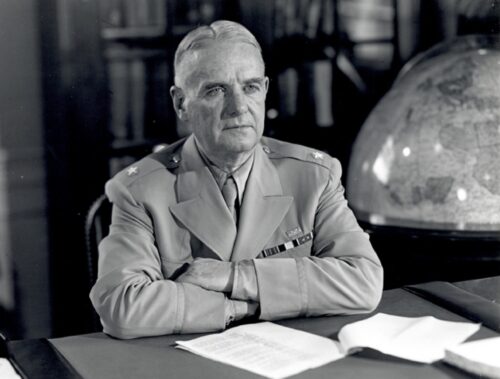
On September 2, 1945, the Empire of Japan surrendered, ending World War II. That same month, President Harry Truman, skeptical that the OSS was needed in the postwar government, signed Executive Order 9621, which disbanded the organization. Still, General William Donovan, who led the OSS, would strive for the OSS legacy to persist after the war. He wanted the public to know and remember the heroics of the men and women of OSS. Donovan encouraged former OSS officers to write articles and memoirs sharing the greatness of the organization’s missions. Many ex-OSS officers with a talent for writing headed straight to Hollywood.
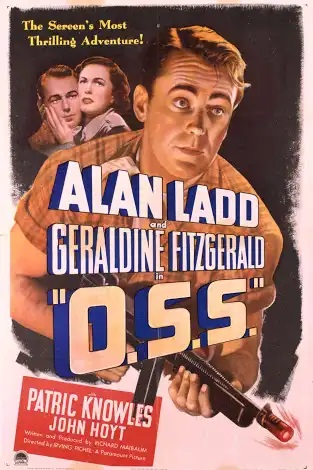
O.S.S.
O.S.S., the first film about the Office of Strategic Services, was released in theaters on May 26, 1946. Directed by Irving Pichel, the film starred Alan Ladd in the lead role. The film tells the story of John Martin, played by Ladd, who is arrested at the beginning of the film for attempted industrial espionage. Martin’s knack for breaking and entering, however, saves him from jail time. Instead, he is turned over to the newly created OSS for training. The OSS, recognizing Martin’s unique skills, sends him to France for his first assignment¹. The film follows Martin and his team as they navigate the dangerous world of espionage during World War II.
The screenplay was written by Richard Maibaum, a World War II veteran who would later write twelve of the first fifteen James Bond films. Maibaum, a former Broadway actor, also narrates the film.
O.S.S. was produced and distributed by Paramount Pictures and portrays the activities of the Office of Strategic Services during World War II. Despite being a work of fiction, the film provides a fascinating glimpse into the world of espionage during this era.
The film was well-received, and its success led to other Hollywood studios producing their own OSS-themed films. O.S.S. thus marked the beginning of a trend that would see the OSS and its operations become a popular subject in Hollywood cinema.
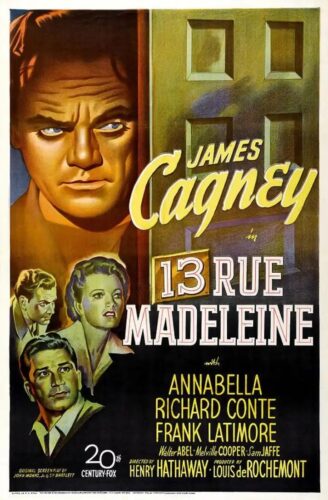
13 Rue Madeleine
One such film was 13 Rue Madeleine (1947), a spy thriller that was being developed in Hollywood around the same time as O.S.S. Released in 1947, this spy thriller was directed by Henry Hathaway and starred James Cagney, Annabella, Richard Conte, and Frank Latimore. The film’s title, 13 Rue Madeleine, refers to the address of a Gestapo headquarters in Le Havre, France. This detail added a layer of realism to the plot, grounding the film’s narrative in a tangible location within the theater of World War II.
The plot of 13 Rue Madeleine revolves around the training of Allied volunteers as spies in the lead-up to the invasion of Europe. However, one of these volunteers is revealed to be a German double agent. The film follows the efforts of the OSS to feed this agent false information about the invasion, while the real agents are sent to France to find a secret V-2 rocket depot.
13 Rue Madeleine was well-received and benefited from the postwar craze for shooting outside the studio. With Quebec doubling for occupied France, this spy movie offered audiences a sense of open air.
Cloak and Dagger
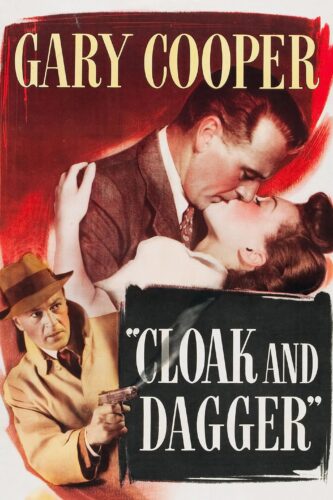
Another notable film was Cloak and Dagger. Released in 1946, this war drama was directed by Fritz Lang and starred Gary Cooper³. The film is based on the 1946 non-fiction book Cloak and Dagger: The Secret Story of the O.S.S. by Corey Ford and Alastair MacBain.
The plot of Cloak and Dagger revolves around an American scientist, played by Gary Cooper, who is sent by the OSS to contact European scientists working on the German nuclear weapons program. Lilli Palmer stars as a member of the Italian resistance movement who shelters and guides him.
Cloak and Dagger is notable for its realistic portrayal of the OSS’s operations during World War II. The film’s narrative, grounded in the real-life experiences of OSS agents, provides audiences with a unique insight into the world of espionage during this era.
While Cloak and Dagger is based on a non-fiction book, the film itself is a work of fiction. As such, its portrayals of OSS operations and agents may not be entirely accurate. However, the film does provide a fascinating look at how Hollywood viewed and portrayed the world of espionage during this era.
Final Thoughts
The relationship between Hollywood and the OSS during World War II was a unique one. It was a time when the glamour of Hollywood and the gritty reality of war intersected, creating a fascinating chapter in both film and military history. The legacy of the OSS continues to be remembered and celebrated, thanks in part to the stories and films that emerged from this remarkable collaboration.
Resources
Central Intelligence Agency
CIA.gov
OSS Society
OSSSociety.org
*The views and opinions expressed on this website are solely those of the original authors and contributors. These views and opinions do not necessarily represent those of Spotter Up Magazine, the administrative staff, and/or any/all contributors to this site.