

THE OPERATION UNFOLDS
Against this backdrop, American military strategists meticulously crafted a plan for a daring rescue mission. Named Operation Eagle Claw, the two-day mission hinged on a rendezvous point, Desert One—a desolate salt flat some 200 miles southeast of Tehran. There, helicopters and C-130 aircraft would converge, facilitating refueling and the deployment of combat troops. From this staging ground, the assault would launch under cover of darkness the following night.
THE TRAGIC OUTCOME
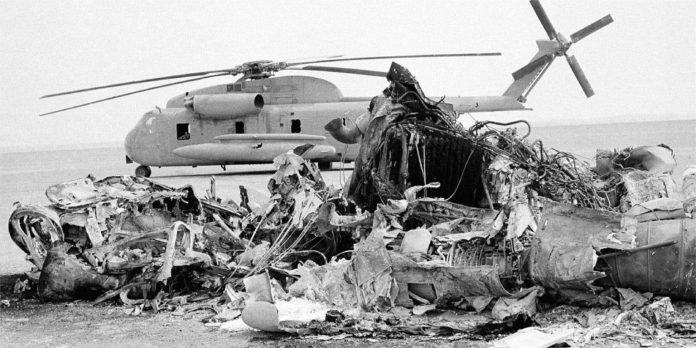
April 24th, 1980, marked the fateful commencement of Operation Eagle Claw. Eight United States Navy RH-53D Sea Stallion helicopters embarked from the deck of the USS Nimitz, navigating a perilous 600-mile journey to rendezvous with six C-130 transport aircraft in the Iranian desert. However, the mission was swiftly besieged by a haboob—a ferocious sandstorm common to desert regions—plunging the operation into chaos. The storm wrought havoc, causing severe visibility impairments, aircraft damage, and illness among crew members. Faced with these insurmountable obstacles, President Carter and his advisors decided to abort the mission.
Amidst preparations for departure, tragedy struck as a RH-53D helicopter collided with a C-130 ferrying supplementary fuel, triggering a catastrophic inferno that claimed the lives of five Airmen and three Marines.
Despite the mission’s failure, Operation Eagle Claw left an indelible mark on military strategy. The events of April 24, 1980, underscored the imperative for cohesion among America’s specialized operational units, resulting in the formation of the Joint Special Operations Command (JSOC) headquartered at Fort Bragg, North Carolina.
Following the failed mission, a battlefield promise was made to 17 American children, and the Special Operations Warrior Foundation was born. The initial mission was to provide a college education for the seventeen children surviving the eight men killed at Desert One. The foundation’s mission expanded over the years to encompass not only those lost in combat but also those who succumbed to training accidents or illnesses related to their service. In 2022, the mission expanded further to include the death of spouses of active-duty Special Operations Personnel.