
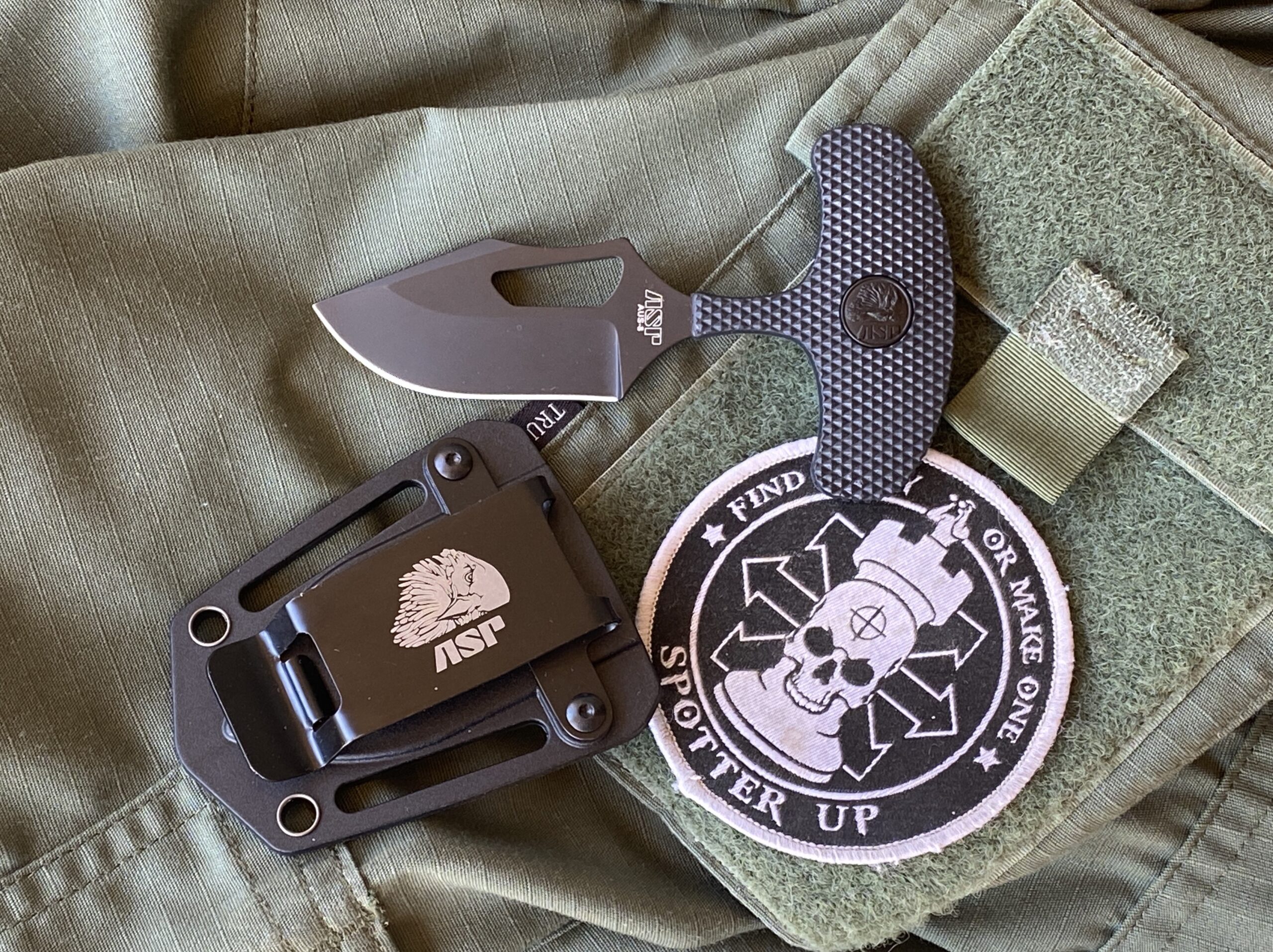
The ASP Police Duty Knife (PDK) Push Knife is designed as a compact, last‑resort defensive tool for law enforcement officers who may face close‑quarters threats, particularly those involving firearm‑retention attempts. Its configuration allows the knife to be carried on the support side and deployed with the non‑dominant hand, enabling the officer’s dominant hand to remain on their duty weapon.
In a lethal force encounter, a knife may be employed for the officer to regain physical stability or advantage to create space before introducing a gun into the fight, or for stopping the threat entirely. Some examples where this may be necessary are when in a lethal clinch, when attacked from behind, on the ground in a bad body position or thrown over objects. It may also be employed as a weapon retention tool in the event of attempted gun grab.
Because the defensive use of any edged tool constitutes a lethal‑force option, proper training is essential. Officers must be familiar with their agency’s policies regarding the carry and use of knives and ensure they are trained in safe, lawful deployment. The PDK Push Knife is intended to supplement—not replace—other defensive tools and techniques.
About ASP
Armament Systems and Procedures (ASP) has spent the past fifty years dedicated to a single mission: equipping law enforcement professionals with tools and training that enhance safety, reliability, and performance in the field. The company’s products are trusted by agencies in more than one hundred countries, a reflection of ASP’s reputation for durability and dependability in life‑critical situations.
ASP dedicates significant resources to research, engineering, prototyping, and testing. Equipment is evaluated in both controlled and field environments, and only items that meet the company’s internal performance and reliability standards are released. This development approach—referred to internally as “ASP DNA”—is intended to maintain consistency across product lines and ensure they meet operational expectations.
The company also offers training programs focused on practical, repeatable, and legally defensible techniques. These programs have been shaped over several decades through field use and feedback from working officers. ASP provides roughly two million dollars’ worth of tuition‑free training to law‑enforcement personnel each year. Its training curriculum has been adopted by agencies in more than one hundred countries

A Brief History of Push Knives
While the modern push knife—often called a push dagger or punch dagger—rose to prominence in the United States during the late 19th century, the underlying concept is far older. Knives with a T‑shaped grip and forward‑projecting blade appear in several ancient cultures, including regions of India, where similar weapons were crafted centuries earlier. These early forms were not identical to today’s compact defensive tools, but they shared the same fundamental geometry: a handle aligned perpendicular to the blade to maximize thrusting power and retention.
The American version of the push dagger became widely recognized in the late 1800s, particularly in the Southern United States, where it served as a discreet self‑defense tool for civilians and lawmen. Its compact size, intuitive grip, and ability to deliver strong, controlled thrusts made it effective even for individuals with limited training.

Push knives eventually found a niche in military use, though not as standard‑issue equipment. During World War I, some soldiers carried small, easily concealed trench knives or improvised push‑dagger‑style blades for close‑quarters fighting in the cramped, chaotic environment of the trenches. By World War II, push knives appeared only in limited, specialized contexts—typically as privately purchased or custom‑made weapons rather than official gear. These wartime examples were generally sturdier and more utilitarian, reflecting the harsh demands of close combat.
In the modern era, push knives have evolved significantly. Many contemporary designs, such as the ASP PDK Push Knife, shift away from double‑edged dagger profiles and toward single‑edge, utility‑capable blades. Today, they are used primarily by law enforcement and military personnel as specialized defensive tools rather than general‑purpose knives, with an emphasis on retention, control, and safe integration into duty gear.
Design and Intended Use
Although the PDK Push Knife is built with defensive scenarios in mind, its design incorporates features that make it suitable for routine utility tasks. The knife uses a 2.25‑inch single‑edge modified clip-point blade shaped with ASP’s Shark Fin™ spine contour. This profile differs from traditional double‑edged push knives, allowing the blade to be used safely for cutting tasks such as slicing seatbelts, opening packaging, or handling other field duties.
The single‑edge configuration reduces accidental injury risk during non‑defensive use while still maintaining the puncture capability expected from a push‑knife format. It is also compliant with jurisdictions that restrict double‑edged knives. Although the knife is single-edged, it is considered a dagger and may be regulated in some areas. Check your local laws.
AUS-8 Steel Blade
The PDK Push Knife’s blade is machined from AUS‑8, a Japanese stainless steel known for its balanced performance in edge retention, corrosion resistance, toughness and accessible price. AUS‑8 contains moderate carbon content and added vanadium, which helps refine the grain structure and improve wear resistance. It sharpens easily in the field—an advantage for officers who may not have access to specialized sharpening tools—and holds a reliable edge suitable for both defensive and utility applications. Its durability and ease of maintenance make it a popular choice for duty‑grade knives. The blades on the sample knives provided to me for evaluation came razor-sharp out of the box.
Black PVD Coating
The blade is treated with a black Physical Vapor Deposition (PVD) coating, a process that bonds a thin, extremely hard layer to the steel. The PVD coating provides abrasion resistance, corrosion protection, and a non‑reflective appearance. For law enforcement use, the matte black finish helps prevent unwanted glare and keeps the knife discreet when carried on a duty belt or vest.

Ergonomic T-Handle
The PDK Push Knife features a T‑shaped handle designed for secure retention and intuitive control, even under stress. This configuration supports gross‑motor‑skill movements, which are more reliable than fine‑motor actions during high‑adrenaline encounters. An asymmetrical grooved surface on one wing of the handle provides a tactile orientation cue: when the grooved side faces upward, the knife is “safe side up” and the sharp edge is down. This helps ensure proper grip and deployment without the need for visual confirmation,
Sheath and Carry Options
Each PDK Push Knife includes a molded polymer sheath engineered for secure retention and versatile mounting. The sheath is completely ambidextrous. A removable spring‑steel clip attaches to belts or gear up to two inches wide, while 1.25‑inch slots allow direct threading through narrower belts or webbing. Four grommeted holes provide additional options for lanyard, ball‑chain, or gear‑lace attachment. This modularity allows officers to configure the knife according to their duty setup and personal preference.

Available Versions
The PDK Push Knife is offered in two versions:
- G Variant – Features a full polymer overmold that encapsulates the handle, providing enhanced grip and comfort.
- S Variant – A skeletonized version that minimizes weight and bulk while maintaining the same blade and sheath compatibility.

Final Thoughts
The ASP PDK Push Knife delivers exactly what a backup blade should: reliability, simplicity, and confidence when space is limited and access matters. Its compact profile, secure grip, and practical blade geometry make it a smart secondary tool for officers who need something fast, intuitive, and low‑maintenance.
With a manufacturer’s suggested retail price of $35.00 for the S (Skeletonized) option and $37.00 for the G (Gripped) option, the PDK Push Knife is an easy addition to a duty belt, vest, or go‑bag without stretching a budget. ASP backs the knife with a limited lifetime warranty against defects in materials and workmanship, reinforcing the company’s reputation for dependable duty‑grade equipment. ASP also offers custom laser engraving on the G version, as with most of the company’s other products.
For anyone looking to round out their defensive or utility loadout with a compact, purpose‑built push knife, the PDK Push Knife is an excellent and cost‑effective choice.
Source
Armament Systems and Procedures (ASP)
Material Disclosure
I received this product as a courtesy from the manufacturer so I could test it and give my honest feedback. I am not bound by any written, verbal or implied contract to give this product a good review. All opinions are my own and are based off my personal experience with the product.
*The views and opinions expressed on this website are solely those of the original authors and contributors. These views and opinions do not necessarily represent those of Spotter Up Magazine, the administrative staff, and/or any/all contributors to this site.