

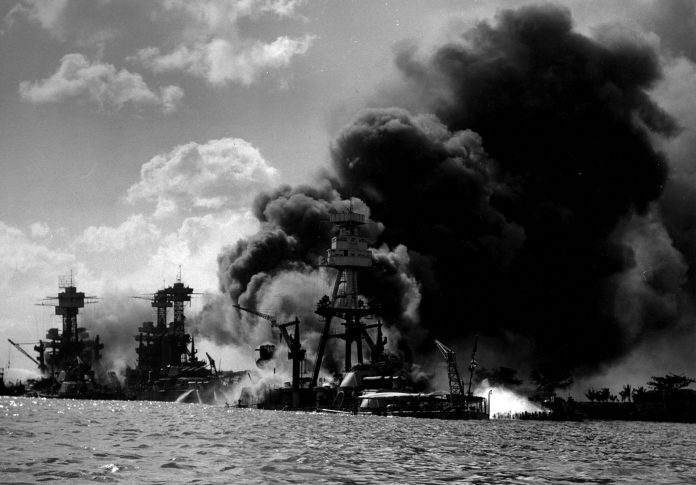
On the morning of December 7, 1941, the United States was thrust abruptly into global war. The Japanese attack on Pearl Harbor shattered any remaining illusions of distance or safety, sending shockwaves through the nation and prompting President Franklin D. Roosevelt to declare war the following day. Americans saw the assault as a sudden and unprovoked blow, a lightning strike from across the Pacific. Yet beneath the surface, the road to war had been paved by years of covert maneuvering, intelligence failures, and unseen battles waged far from the shores of Hawaii.
Long before the bombs fell on Pearl Harbor, the struggle between nations had already reached deep into the American homeland. Few places felt this hidden conflict more intensely than New York City
In the months leading up to America’s entry into World War II, New York City was more than a cultural and financial powerhouse, it was one of the most active intelligence battlegrounds in the world. Its ports, shipping companies, foreign consulates, and international businesses made it a natural magnet for spies from every major power, each drawn to the city’s unique blend of opportunity and anonymity.
German, Japanese, British, and American operatives moved through the same crowded streets, often unaware of how closely their paths overlapped. Times Square, with its constant motion and dense crowds, offered ideal cover for clandestine meetings, surveillance, and the quiet exchange of information. In a place where a person could disappear into the flow of pedestrians within seconds, intelligence services frequently collided without the public ever realizing it.
The Abwehr’s Operations in the United States
Germany’s military intelligence service, the Abwehr, had been active in the United States since the 1930s. Its mission was to gather strategic information on American industrial capacity, naval movements, and military installations.
To accomplish this, the Abwehr recruited agents from a wide range of backgrounds: naturalized German immigrants, sailors, businessmen, and opportunists, placing them in positions where they could observe American activity firsthand.
Their operations ranged from mapping East Coast ports to tracking shipments of war materials bound for Britain and even attempting to infiltrate defense contractors. These efforts reached their peak with the Duquesne Spy Ring, a network of 33 agents led by Frederick “Fritz” Duquesne. Through wiretaps, informants, and undercover work, the FBI dismantled the ring in December 1941, just days before the attack on Pearl Harbor. It remains the largest espionage conviction in U.S. history and a stark reminder of how deeply foreign int
Japan’s Longstanding Interest in Pearl Harbor
While Germany focused on industrial and naval intelligence, Japan pursued a far more specific objective: the U.S. Pacific Fleet anchored at Pearl Harbor. Japanese intelligence efforts in Hawaii dated back to the 1930s, long before war with the United States seemed inevitable. Operatives working under diplomatic or commercial cover collected detailed information on battleship and aircraft carrier movements, harbor depth, anchorage patterns, and the layout of nearby airfields such as Hickam Field.
One of the most important figures in this effort was Takeo Yoshikawa, a Japanese naval officer posing as a junior diplomat in Honolulu. His reports, combined with aerial reconnaissance and naval planning, helped shape the attack plan that would unfold on December 7, 1941. Although Germany and Japan occasionally exchanged intelligence, their cooperation was inconsistent. Even so, both nations viewed American military readiness as a critical factor in their strategic calculations.
The Arrival of Dusko Popov—A Double Agent in America
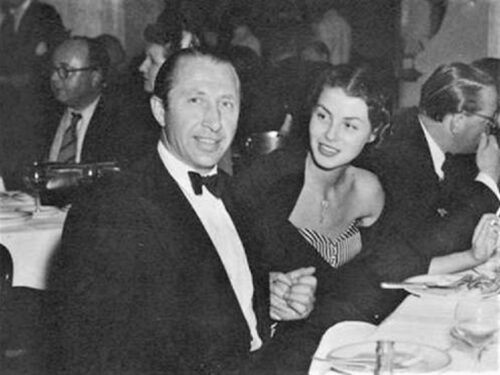
Into this world of intrigue stepped one of the most remarkable figures of the era: Dušan “Dusko” Popov, a Serbian lawyer, gambler, and double agent working for Britain’s Secret Intelligence Service (SIS), commonly known as MI6. Popov had been recruited by the Abwehr, which believed he was loyal to Germany. In reality, he was part of the British Double Cross System, administered by the Security Service (MI5), feeding the Germans carefully curated disinformation.
British intelligence assigned Popov the codename “TRICYCLE” because SIS believed he would serve as the central coordinator for a small network of three agents within the Double Cross System. The name reflected the expectation that Popov would act as a hub, much like the central wheel of a tricycle, directing multiple operatives while feeding controlled information back to the Abwehr. Although he did not always manage three sub‑agents simultaneously, the codename captured his intended role in British deception operations and has been consistently cited by intelligence historians as the accepted explanation for its origin.
In August 1941, Popov arrived in the United States on an Abwehr mission, carrying a lengthy questionnaire listing intelligence targets the Germans wanted information on. Among these documents was a section requesting detailed information about Pearl Harbor’s defenses, ship dispositions, and airfields. Recognizing that the questions indicated Japanese interest in the harbor, Popov attempted to alert the FBI. Although he offered no specific warning of an attack, and the Germans themselves had no knowledge of Japanese plans, his concerns were dismissed by the Bureau.
MI6 was aware of the questionnaire but did not treat it as evidence of an imminent Japanese operation. Before America entered the war, MI6’s official channel to U.S. authorities was the FBI, and Popov’s mission required him to report his material directly to them. British intelligence therefore relied on Popov to convey the information, assuming the FBI would evaluate it appropriately.
Hoover’s Dismissal and a Missed Warning
Popov met with FBI officials in August 1941, but Director J. Edgar Hoover quickly developed a deep suspicion of him based on internal reports. Hoover disliked Popov’s flamboyant lifestyle and distrusted double agents on principle, viewing them as inherently unreliable and potentially manipulative. His longstanding rivalry with British intelligence, whom he often treated as competitors rather than partners, further colored his view of any MI6‑connected source. Although Britain was conducting influence operations in the United States at the time, there is no evidence that Hoover believed Popov was part of such efforts; his hostility stemmed primarily from personal distaste, institutional jealousy, and a desire to maintain control over intelligence operations on U.S. soil.
The FBI also failed to grasp the significance of the Abwehr questionnaire Popov carried, which included detailed questions about Pearl Harbor. Lacking military expertise and wary of acting on intelligence they did not originate, Bureau officials treated the document as routine rather than as a potential indicator of Japanese intentions. Hoover’s risk‑averse leadership style reinforced this inertia. As a result, the information was not passed to U.S. military planners in a way that might have prompted further scrutiny.
The episode illustrates how personal bias, bureaucratic rivalry, and poor inter‑agency communication undermined the handling of Popov’s intelligence. While Popov did not possess a specific warning of the attack on Pearl Harbor, the FBI’s dismissal of his material remains a notable example of a missed opportunity in pre‑war intelligence coordination.
The Broader Intelligence Landscape Before the Attack
Popov’s information was not the only indication of rising danger. In the months before December 1941, U.S. cryptanalysts had broken Japanese diplomatic codes, revealing that Tokyo was preparing for major military action and that negotiations with Washington were collapsing. Japanese consulates were also gathering detailed intelligence on American naval bases, including Pearl Harbor. Yet bureaucratic rivalries, fragmented intelligence, and a widespread belief that Japan would strike in Southeast Asia rather than Hawaii contributed to a tragic underestimation of the threat. The result was one of the most consequential intelligence failures in American history.
Post‑Pearl Harbor Reforms
The failures that culminated in the surprise at Pearl Harbor exposed deep structural weaknesses in the American intelligence system. Although Popov’s case remained classified for decades and played no direct role in wartime decision‑making, the broader pattern it exemplified, fragmented intelligence, inter‑agency rivalry, and the absence of centralized analysis, was widely recognized in internal reviews after the attack. These assessments helped drive major reforms. In 1942, President Roosevelt created the Office of Strategic Services (OSS), the first U.S. agency designed to coordinate foreign intelligence and conduct global espionage, marking a decisive shift away from the pre‑war system in which the FBI, Army, Navy, and State Department operated largely in isolation.
The war also reduced the FBI’s role in foreign intelligence as responsibility for overseas espionage and strategic analysis shifted to the OSS. After the war, the National Security Act of 1947 established the CIA, the National Security Council, and the Department of Defense, creating a permanent national security structure intended to ensure that intelligence flowed more effectively to policymakers. The U.S. military likewise implemented reforms, developing joint intelligence centers, more sophisticated analytical units, and standardized procedures for evaluating and disseminating threat information.
While Popov’s experience was not a direct catalyst for these reforms, it stands as a vivid example of the institutional rivalries, personal biases, and coordination failures that the post‑war intelligence architecture sought to eliminate.
The Inspiration for James Bond
Popov’s charisma, daring, and high‑risk operations left a deep impression on many who encountered him. Among them was Ian Fleming, who served in British Naval Intelligence during the war. Fleming later acknowledged that James Bond was inspired by several real agents, and Popov is widely regarded by historians as one of the notable influences.
Bond’s cool demeanor, appetite for risk, and ability to move effortlessly between high society and the criminal underworld echo elements of Popov’s real‑life exploits. Popov was known to gamble large sums at Casino Estoril in Portugal, a glamorous wartime crossroads where Allied and Axis agents often watched one another across the baccarat tables. According to several accounts, Fleming observed Popov’s audacious play there, an episode that helped inspire the famous casino opening of Casino Royale. From such real encounters in the shadowy world of wartime espionage emerged one of the most enduring fictional heroes of the twentieth century.
Final Thoughts
The months before Pearl Harbor were defined by a complex web of espionage, warnings, and missed opportunities. New York City served as a stage where foreign agents maneuvered in the shadows, each playing a small part in a global drama that would soon erupt into full‑scale war.
The Abwehr’s activities, Japan’s intelligence gathering, and Popov’s overlooked concerns reveal a world where truth and deception intertwined, and where critical signals were often lost amid bureaucratic rivalry and analytical blind spots. This era reminds us that intelligence failures rarely stem from a single error, but from a chain of misjudgments, assumptions, and warnings that went unrecognized until it was too late.