

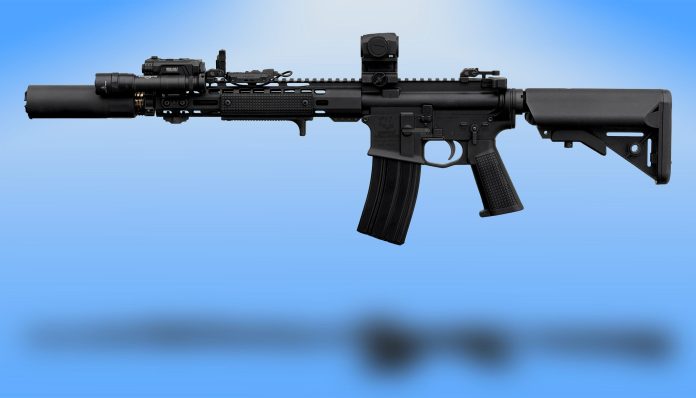
I’ve been a fan of Griffin Armament for a while, having used their M2 iron sights for years, enjoying the quality of their silencers, and, more recently, appreciating significant value in their optics line after reviewing the 1-10x Mil-R SFP LPVO. Perhaps I’ve been working backwards, but it made sense that I should take one of the company’s rifles for a spin, and what better than the close quarters configuration of the day, the Griffin Armament MK2 CQB 11.5″.
As America’s rifle, the AR-15 has no shortage of manufacturers competing for a spot on your shopping list. Why shouldn’t they? Eugene Stoner’s modular masterpiece lets shooters have it their way, without an annoyingly catchy jingle to back it up. How, then, fast-food references aside, is one to decide which is right for them? Griffin Armament answers that question with its MK2 series of rifles, offering value through premium parts, loaded-out-of-the-box features and upgrades, and end-to-end quality control with every part of the MK2 series made in-house.
Additionally, you’ll find that my Griffin Armament MK2 11.5” CQB is a one-stop solution, other than my Surefire Scout Light and Holosun IRIS GR3 laser aiming module. This gives me a whole new level of appreciation for the idea of a “factory rifle,” as I can get an optic, mount, silencer, and almost anything else I need straight from Griffin Armament.
11.5” Supremacy…
During the late 1990s through the 2000s, the MK18 emerged from the Close Quarters Battle Receiver (CQBR) project, gaining significant popularity within the US Special Operations community and becoming a reliable, compact rifle for shipboard and vehicle use. Widely adopted by Special Mission Units (SMUs), the MK18 later found its way into broader military and law enforcement use by the mid-2000s, prompting a surge of popularity in the commercial market.
Fast-forward to that abrupt transition when we all realized the MK18’s 10.3” barrel rendered our beloved 5.56x45mm somewhat anemic, pointing us instead to what may be the decided-upon winner in the short AR game: the 11.5”. The bump in velocity it provided put much-needed authority back into the venerable NATO cartridge. The added length also increased dwell time, the duration in which the projectile continues down the barrel after passing the gas port, leading to a reduction in gas port size. By reducing the volume of gas needed to cycle the action, benefits include increased reliability and parts longevity, a smoother, more manageable recoil impulse, and less gas reaching the shooter’s face and lungs.
That’s a lot of upside at the cost of approximately one extra inch up front, solidifying the 11.5” as the length du jour for close quarters work, like home defense.
MK2 Lower Receiver…
Griffin Armament offers shooters all the high-end ergonomic features typical of billet receivers, but the MK2 lower is machined from custom-forged 7075-T6 aluminum. While there are some very nice billet sets on the market, I generally prefer forged, as the process creates a dense grain structure that enhances the receiver’s inherent strength. Well, now you can eat your cake and have it too.
The Griffin Armament MK2 lower receiver features fully ambidextrous controls, including magazine release, bolt catch/release, and Safety Selector Kit. It is also machined to include a 60-degree flared magazine well for fast reloads and an integrated, enlarged trigger guard for use with gloves. I really like that Griffin Armament included a protective shelf on the left side of the receiver to prevent accidental magazine ejection. Additionally, the right-side bolt catch/release is my favorite way to accomplish this ambidextrous feature as a right-hander, placing the lever in an optimal position for me to manipulate it with my trigger finger: simply lifting it to lock the bolt back and pushing it down to release.


The MK2 lower is also equipped with Griffin Armament’s Dimpled Takedown Pins, which protect the receiver’s finish by preventing tools from slipping and marring when you need to push them out. The receiver is capped at the rear with Griffin’s Contour Connect QD End Plate, their Maritime Receiver Extension for proper drainage during over-the-beach swimming pool LARPs, and the company’s AR-SOB (Suppressor Optimized Buffer). This staggered-impact hybrid buffer design is a key, often-overlooked component that reduces the system’s operating speed, providing smooth cycling and reliable feeding with fouled chambers while preventing premature unlocking of the bolt, which can cause unnecessary extraction stress and contribute to the failure of critical system components.


My MK2 shipped with a Griffin Armament Adjustable 2-Stage Match Trigger, featuring a very short initial stage, a crisp 4-pound break, and an almost immediate tactile rest. This is a Milazzo-Krieger-style adjustable match trigger that combines MIL-SPEC 62RC 8620 trigger material and a case-hardening heat-treatment regimen with a 53RC 440C disconnector and a nickel-teflon-coated, lightened tool-steel speed hammer. My trigger came pre-adjusted for overtravel from the factory and has been excellent. I’d recommend the Griffin Adjustable 2-Stage for any AR-15, including your precision SPR applications. I may need a few more of these in my life.


Lastly, the MK2’s lower receiver features a Griffin Armament A3 Grip, providing a comfortable grip angle and texture for positive weapon retention, while omitting a beavertail for ease of selector manipulation.
MK2 Upper Receiver…
The Griffin Armament MK2 forged upper receiver, like the lower, is Type 3 hardcoat anodized for enhanced durability and corrosion resistance, and manufactured using state-of-the-art aerospace technology to achieve sub-mil-spec tolerances. Beyond this foundation, the heart of any AR-15 lies in the bolt carrier group (BCG) and barrel, two more areas where Griffin Armament refuses to cut corners.
The Griffin Enhanced BCG features an 8620 carrier and Carpenter-158 bolt, with a 4340 cam pin and extractor. Every component of the BCG is billet-machined; no cast components here, and all surfaces receive a finishing pass for improved smoothness. From heat treating to shot peening to post-heat treating, Griffin Armament spared no expense on materials and manufacturing processes, including the BCG’s Melonite QPQ (Quench-Polish-Quench) finish, providing enhanced lubricity for a slick, reliable action. Each carrier features Permatex’d and properly staked carrier keys, a 15,000-round extractor spring, and a Crane O-ring for reliable extraction in austere conditions.
Griffin Armament’s 416R Stainless Steel HEPD (High-Endurance Dual-Purpose) barrels are another factor that sets the MK2 apart from other AR-15s on the market, offering increased durability and accuracy from the Nitrided stainless-steel 5R rifled barrel. According to Griffin Armament, this provides maximum hardness and the longest throat life available with match-grade bore dimensions and finish. Each of these HEPD barrels is hand-lapped to ensure accuracy and consistency across batches, and chambered in .223 Wylde for optimal performance with varying 5.56 NATO and .223 ammunition.
Much of the MK2 agenda focuses on enhancing the suppressed shooting experience, like the Griffin Armament ambidextrous SN-ACH Gen 2 charging handle that directs gas forward and away from the shooter’s face. The chamber and M4 feed ramps are polished before nitriding to ensure smooth, reliable feeding and extraction, and the gas port is meticulously tuned to provide consistent function whether running suppressed or unsuppressed. The barrel’s contour from the chamber to the gas block also follows the M4A1 pattern, minimizing point-of-impact shift with suppressor attachment and removal while maximizing accuracy and durability. A nitrided 416R crucible alloy steel Griffin Primo Gas Block is installed and pinned, and the barrel features True-Bore concentric suppressor grade threads for optimized concentricity that won’t leave you worried about baffle strikes.
Lastly, the MK2’s HEPD barrel is capped with a Griffin Silencer Mount Muzzle Device. Mine in particular came with the Griffin Armament Dual-Lok Closed Tine Flash Hider. This muzzle device was designed to enhance flash suppression and reduce muzzle flip when compared to A2 flash hiders, with closed tines minimizing snagging through thick vegetation, if you’re into that sort of thing. It also features a BFA groove for compatibility with Bore Sight Collimators and Blank Firing Adapters. The Dual-Lok Closed Tine Flash Hider is machined from a solid bar of heat-treated 17-4ph stainless steel and built to exacting specifications, just like the rest of the Griffin Armament MK2, making it not only effective as a stand-alone device, but also a suppressor host. More on that later.
Shielding the barrel while providing a rock-solid user interface is the Griffin Armament Low Pro Rail System, a rigid yet slim, low-profile, and ultralight handguard with M-LOK slots at the 3, 6, and 9 o’clock positions for mounting your favorite accessories, and a rounded profile that provides a comfortable grip. Designed to maximize rigidity with significant internal reinforcement to reduce flex when driving the carbine firmly into the shoulder pocket, the Griffin Low Pro Rail System makes for an optimal laser-aiming host, with severely reduced deflection and point-of-impact shift compared to similar-style “slim rails.” The rail also features a generous number of tastefully smooth cuts that allow rapid heat dissipation from the barrel, keeping your grip cooler for extended periods on those days when you forget to bring gloves.


The handguard is installed via a slip-fitted clamp design that is affixed to a heavy-duty, 17-4 stainless steel H900 heat-treated barrel nut. The system is very rigid, but if I were to nitpick, moving to an indexed locking system that does not rely on clamping force might be a decent upgrade. I’m not sure how much, if anything practical, would really improve by doing this, but I have to suggest something, don’t I? That’s how good this rifle is.
Lastly, I want to discuss a pair of bonus items that come with Griffin Armament MK2 rifles that really put the warm and fuzzies in my ballistic sensibilities. Those two items are the Griffin RailShield 4-Piece Panel Kit and the M2 Iron Sight Kit. The RailShield handguard covers are made for hard use. Unlike competing options with plastic snap-on attachments, these grip panels use grade 5 fasteners for solid engagement. An optional panel with a built-in handstop comes mounted at the 6 o’clock position, and the textured surfaces of the panels make them comfortable and easy to grip in any weather.

The M2 Iron Sights are a perfect addition, making the Griffin MK2 CQB usable right out of the box. Not only do I wish more manufacturers did this, but I wish they did it as well as Griffin Armament. I have been using the M2 (Micro Modular) sights for years on many rifles. Not only are they wildly affordable considering their QPQ-treated 17-4 and ordnance-grade steel construction, but M2 sights are also an industry first with their patent-pending modular base plate system that makes it possible to attach them to Griffin Armament’s optional ambidextrous M2 Offset Baseplate Set if 45-degree irons are your thing. These sights are very snag-free and low profile, clearing most ocular lens housings even when mounted with a 1.5” optic mount, and easily clearing my cantilevered Griffin Armament 3X Prism. Having such a minimal footprint with only 2.5 ounces in additional weight already makes these the perfect backup sights, but the fact that they’re included with the rifle is like a chef’s kiss from the factory.


Suppressed…
When I set out to review the MK2 11.5” CQB, the plan was to test the rifle with a Griffin Armament Dual-Lok 5 Suppressor, with a 17-4 stainless steel & 718 Inconel laser-welded and tubeless design that measures 6.5”x1.5” and weighs in at 11.8 ounces. This silencer has been around for a while and has earned an excellent reputation for strength and durability, while also providing effective sound and flash reduction. The Dual-Lok 5 combines Griffin’s ECO-FLOW baffle technology with a patented low-profile flash-suppressing end cap that allows excess gases to vent forward and away from the shooter’s face. The Dual-Lok design provides a rock-solid, wear-free locking mount that minimizes point-of-impact shift. No surprises here, as the Dual-Lok 5 lives up to the hype.
Griffin Armament then asked if I would like to try out their new Optimus 6, a 3D-printed, ultra-strong 17-4 stainless steel silencer optimized for 5.56mm and capable of suppressing 6mm projectiles while maintaining performance. The Optimus 6 measures 6.68″x1.73” and weighs 17.2 ounces for the Dual-Lok model that I’m currently using, but is also available in Plan-A taper mount and HUB compatible versions. This suppressor, while larger and heavier than the Dual-Lok 5, is still relatively small and light, with the difference in overall length being diminutive, and additional volume coming by way of girth. The blast shield and mounting portion of the Optimus 6 are laser-welded to the baffle core, allowing Griffin Armament to repair the silencer in the event of a baffle strike or catastrophic failure, and post-production machining ensures a smooth exterior surface absent the texture typically visible in other 3D-printed suppressors.

The Optimus 6 is designed for extreme flow-through of suppressor gases, moving several steps ahead of the Dual-Lok 5 in keeping those gases out of your face and lungs, and the quad-tine flash hider endcap was tuned in conjunction with the low backpressure baffle stack to eliminate flash at a level I have yet to experience in other low backpressure suppressors. Of course, increasing flow, decreasing back pressure, and having a slightly oversized bore do not come without sacrifices, if you can call them that. As good as the Dual-Lok 5 is, I can absolutely tell the difference in gas flow during longer shooting schedules. The trade-off should be sound and flash suppression, but I didn’t notice. In fact, one of the topics we don’t see people talk about too often when it comes to suppression is tone, and I believe the tone of the Optimus 6 is such that it sounds quieter than it is, taking the edge off and providing that Dual-Lok 5 type performance with less gas to the face.


Both suppressors utilize Griffin Armament’s Dual-Lok interface for attaching them to the muzzle device. I have become a fan of taper mounts over the years for their repeatability and tendency to remain in place over long periods of use; however, Griffin decided to add one more layer of security, with the Dual-Lok system, using a set of teeth at the base of the muzzle device to guarantee your suppressor will not back off, and that your point of impact is consistent.
Asking me which I’d choose is a difficult proposition because both silencers are fantastic, but if I had to pick one right now… I’d buy both because I don’t like making these kinds of decisions, and I’m bad at following instructions. Don’t judge me.
The Setup…
The Griffin Armament MK2 CQB 11.5″ is quick and nimble on the range. For that reason, I tried out several optics configurations while keeping the rifle to my factory theme. It was tempting to run it with the Griffin Armament 1-10 LPVO I reviewed, since the optic ran so well and currently has a Griffin Micro Sight Acro footprint green dot at 12 o’clock. This is made possible using Griffin’s Lightweight GPM Cantilever Mount in conjunction with their AIS top plate. These mounts offer a wide range of factory solutions for offset and piggyback mounting and provide a rock-solid base for any optic. This would definitely have been a robust, capable setup, but perhaps a bit much for what is predominantly a CQB rifle.


My next choices were Griffin’s 1x and 3x Prism Sights, but my 1x is currently pulling duty on the Griffin Armament MK2 9mm 4.5” SD, and that little guy is so fun to shoot that I’m not touching it. Review coming soon. The 3x, however, performed great, and as I mentioned earlier, had enough clearance with its cantilever mount to maintain my rear M2 iron sight. Overall, this setup was a lot like running an ACOG, and the glass is crystal clear. I also really love the reticle in this optic, something Griffin Armament calls an Ideal Carbine Optic (ICO) BDC reticle. From elevation and windage holds to ranging capability, this reticle does it all without cluttering up the view. Lastly, these prisms use the T1/T2 mount, which means you will have many mounting options beyond those provided with the optic. I decided to run it with Griffin’s new 1.3” Cantilever QD mount and found it to be an excellent setup.


Since I’m more of a piggyback than an offset optic guy, and the Griffin Armament MK2 CQB 11.5” begs to go fast in a manner only Ricky Bobby would appreciate, I ended up finding the temperature just right with the new T1/T2 footprint Griffin Red Dot Sight on a 1.55” QD Mount, perfect for a lower 1/3 iron sight window. Even though this optic uses the T1/T2 footprint, it is considerably smaller compared to my other optics with the same mounting system. With a 50,000-hour battery life, fog and shockproof construction, 10 brightness settings, a 4-MOA dot, and shake-awake technology, this ended up being my final choice for the review.


Lastly, I went with a Surefire Scout Light Pro and Holosun IRIS GR3 so I could have some fun when the sun went down, and SBR’d the Griffin Armament MK2 with the addition of a B5 Systems Enhanced SOPMOD Stock.

At the Range…
None of this is possible without the support and generosity of some of the finest ammunition manufacturers in America. That’s why I want to give special thanks to Hop Munitions, AAC, and Black Hills for supplying me with some of their best 77gr .223 and 5.56mm NATO cartridges. When working with 5.56mm NATO in a short barrel, it is a good idea to select a projectile less dependent on velocity for terminal performance, which is why I chose to set up and run the Griffin Armament MK2 CQB on 77gr rounds that are optimal for personal and home defense.

I set the rifle for point-blank range as I typically do and determined that a 40-yard zero would give me a 5” target size (2.5” high or low from point of aim) out to approximately 235 yards and a far zero of 200 yards. This is my favorite way to set up a rifle like this for quick shots within a known range. Take the time to familiarize yourself with your trajectory and sight height when you do this, as that information will help you fine-tune shots that need to be right on the money. For example, with a height over bore of around 2.8”, I know my point of impact will be lower until it converges with my point of aim at 40 yards. In contrast, I know that my point of impact will be around 2.25” high at 100 yards.


Now that my setup was good to go, it was time to test accuracy. I shot unmagnified from my tripod, yielding excellent results and making me wonder how much more I could possibly squeeze out of it if I had used a magnifier or scope, but that’s really not what this rifle is meant for. I’d be willing to bet this barrel will shoot 1 MOA, and that’s something to write home about for most AR-15s.


With my Griffin Armament MK2 set up just how I want it, it was time for my favorite part of the review process: getting out from behind the tripod and engaging targets at distances ranging from CQB to 400 yards. I started off with a magazine unsuppressed, just to say I did. The MK2 ran excellently, and I did not notice any perceptible shift in impact without the silencer. That’s a huge win for me, but as a guy with tinnitus in both ears, I did what I do and ran the rest of the review with the Optimus 6 attached.
From the gas system and BCG to the charging handle, suppressor, and everything else that Griffin Armament thought of to optimize the MK2 for suppressed use, this is where it all comes together. The sound, tone, and flash performance were top-notch on such a short rifle, but perhaps even more remarkable was the lack of choking and crying from being hosed in the face during long strings of fire.
I’m not sure how many rounds I went through by the end of the review, but that’s what happens when a rifle runs flawlessly and entertains me to no end. I think I have approximately 2200 rounds through Griffin MK2 as I write this, and I keep taking the rifle out whenever I head to the range for some “personal time.”

Final Thoughts…
As with any purchase, consider your application environment. Since most self-defense scenarios do not occur at long range, personal defense weapons (PDWs) and short-barreled firearms in either a rifle or pistol configuration are extremely practical. This is where the Griffin Armament MK2 11.5” CQB excels, weighing 6lbs 5oz from the factory with an overall collapsed length of 28″.
You know what else is practical? MSRP for the MK2 CQB is $ 1,719.95, but Griffin Armament loves you and seems to always run specials on its website, which now lists the CQB at $1,449.95. I’m not saying it isn’t a healthy purchase, but I am confident the value is there, with features and quality control that will never leave you wanting. From the unassuming milspec-like forged receiver set with integrated ambidextrous controls and nicely flared Magwell, to the MK2’s tight fit and solid reliability, to its finely-tuned carbine gas and buffer system, this rifle represents a considerable bang for the buck.
Keep in mind that .gov extortion payments on silencers, short-barreled firearms, and AOWs have been discontinued, for now. There has never been a better time to set up a fighting rifle for your personal and home defense needs that will serve your children’s children one day, and the MK2 11.5” CQB is a perfect choice to pull that duty. It stands to reason that manufacturers would optimize their AR-15s for suppressor use these days, but that costs money, and everything takes time when the devil is in the details. This is where Griffin Armament’s extensive silencer manufacturing history and excellent reputation come into play. They’ve figured it out for you and continue to develop components that bring reliability and performance to the table while remaining sensible with their pricing, all qualities that solidify Griffin Armament as a great American firearms manufacturer and a steadfast supporter of the Second Amendment.
To see the wide range of firearms, silencers, optics, parts, and accessories offered by Griffin Armament, please visit griffinarmament.com.