

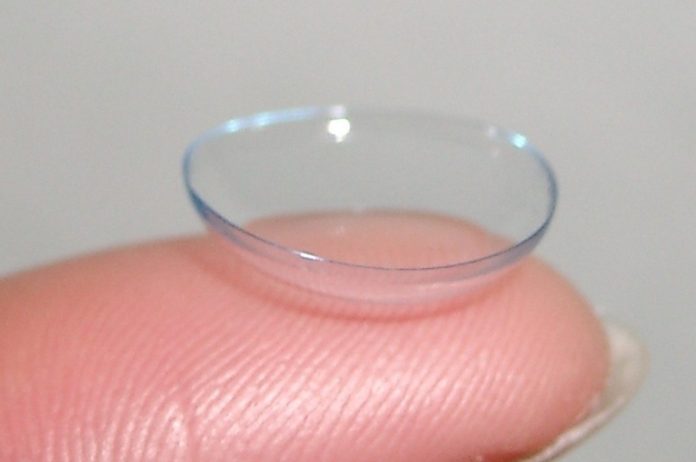
Photo: Wikimedia. Photographed by Bpw / GFDL.
Scientists at the University of Science and Technology of China have developed groundbreaking contact lenses that allow wearers to see in the dark using infrared vision—and remarkably, they work even when the wearer’s eyes are closed. Unlike traditional night vision goggles, these innovative lenses don’t require any power source. They utilize specialized nanoparticles that absorb infrared light and convert it into wavelengths visible to the human eye, working in the near-infrared range of 800 to 1,600 nanometers.
“Our research opens up the potential for non-invasive wearable devices to give people super-vision,” says senior author Tian Xue, a neuroscientist at the University of Science and Technology of China. The technology combines these special nanoparticles with flexible, non-toxic polymers commonly used in standard soft contact lenses.
The effectiveness of these lenses has been demonstrated through both human and animal trials. In tests with mice, animals wearing the lenses could distinguish between a dark box and an infrared-illuminated box, consistently choosing the dark box, while mice without the lenses showed no preference. Human participants successfully detected flashing infrared signals and could determine the direction of incoming infrared light.
Interestingly, the technology works even better when users close their eyes. “Near-infrared light penetrates the eyelid more effectively than visible light, so there is less interference from visible light,” explains Xue.
Currently, the lenses can only detect high-intensity infrared signals from LED light sources. However, researchers are working to enhance the nanoparticles’ sensitivity to detect lower levels of infrared light. The technology shows promise for various applications, including security operations, rescue missions, and anti-counterfeiting measures.
The research team is also exploring additional applications, such as helping color-blind individuals see colors. By modifying the nanoparticles to convert different wavelengths, they could potentially make invisible colors visible to those with color blindness.
These revolutionary lenses, detailed in the scientific journal Cell, represent a significant advancement in wearable vision enhancement technology, offering a more practical and comfortable alternative to traditional night vision equipment.
Building on the revolutionary technology, military experts are closely monitoring these infrared-capable contact lenses for their transformative potential in modern warfare and special operations. Unlike traditional night vision equipment, which can be cumbersome and limit mobility, these contact lenses offer warriors unprecedented freedom of movement while maintaining superior situational awareness in darkness.
The military implications are particularly significant for special forces and covert operations. Soldiers could operate in complete darkness without the telltale silhouette of night vision goggles, making them virtually undetectable while maintaining full visual capabilities.
Combat effectiveness could see a dramatic improvement as well. Traditional night vision equipment often restricts peripheral vision and depth perception, but these contact lenses would provide a more natural field of view. Additionally, the absence of any power source eliminates the risk of battery failure during critical operations and removes any electronic signature that enemy forces might potentially detect.
Search and rescue operations, both military and civilian, could benefit enormously from this technology. The ability to detect infrared signatures could help locate missing personnel or identify hidden threats without the need for bulky equipment that might impede rescue efforts. In disaster scenarios, these lenses could prove invaluable for first responders working in low-light conditions or smoke-filled environments.
However, military adoption would require extensive testing and development. The current technology’s limitation to high-intensity infrared sources would need to be addressed for battlefield applications. Additionally, the lenses would need to demonstrate reliability in extreme conditions, from arctic cold to desert heat, and maintain functionality under the stress of combat operations.
This new dimension of the technology’s potential applications further underscores the groundbreaking nature of these infrared-detecting contact lenses, suggesting they may not only transform civilian life but also reshape modern military capabilities. As development continues, we may see these lenses become a standard part of military equipment, fundamentally changing how operations are conducted in low-light conditions.