

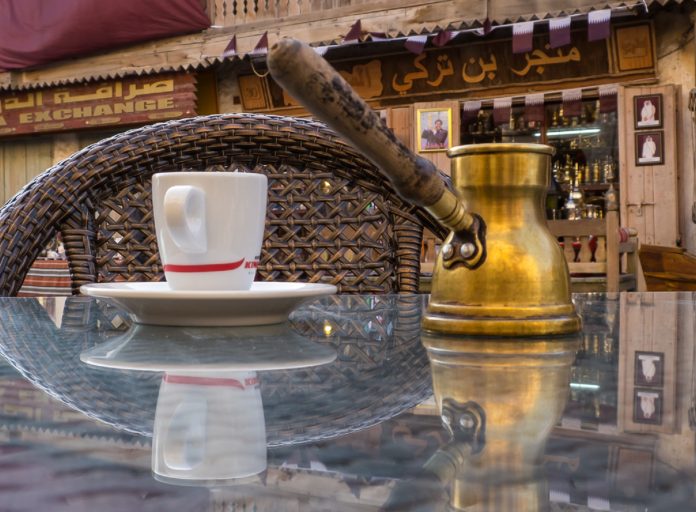
Arabic coffee at Souq Waqif in Doha, Qatar. Wikimedia by StellarD / CC By-SA 4.0.
Few beverages carry the weight of history, tradition, and hospitality quite like Arabic coffee. Known as qahwa, this fragrant, spiced brew is more than just a morning pick-me-up—it is a symbol of generosity, a ritual of welcome, and a cherished element of Middle Eastern culture. From the bustling markets of Mokha, Yemen, where coffee cultivation first took root, to the elaborate ceremonies in Gulf households, Arabic coffee has shaped social customs for centuries.
History of Arabic Coffee
Arabic coffee has a fascinating history that intertwines with trade, religion, and cultural traditions. While its cultivation began in Mokha, Yemen, the story of coffee stretches back even further to Ethiopia, where legend credits a 9th-century goat herder named Kaldi with its discovery. Kaldi noticed his goats became unusually energetic after eating red berries from a certain shrub. Curious, he tried the berries himself and experienced a similar boost. He shared his findings with local monks, who began using the berries to stay awake during long prayers.
By the 15th century, Yemeni traders had begun cultivating coffee plants and exporting them through the port of Mokha, which became synonymous with high-quality coffee. The drink quickly gained popularity in Mecca, where the first coffeehouses emerged, serving as social hubs for discussions, poetry readings, and business meetings.
From Yemen, coffee spread to Egypt, the Levant, and Turkey, where it became an integral part of daily life. The Ottoman Empire embraced coffee culture, establishing coffeehouses known as qahveh khaneh, which became centers for intellectual exchange. By the 16th century, coffee had reached Venice, where the first European coffeehouse opened in 1645.
The word “coffee” itself originates from the Arabic term qahwa, which initially referred to wine but later became associated with the stimulating drink. As coffee gained popularity, European colonial powers sought to cultivate it in their territories, leading to its spread to India, Indonesia, and the Americas.

An Intangible Cultural Heritage
Arabic coffee is much more than just a beverage. It represents hospitality, tradition, and social connection. In many Arab cultures, serving coffee is a ceremonial act, often accompanied by elaborate rituals. The preparation and presentation of Arabic coffee vary by region, but it is universally recognized as a symbol of generosity.
In Saudi Arabia, the UAE, and Qatar, Arabic coffee is often served in small cups (finjan) alongside dates, signifying respect and warmth. The Bedouin tribes of the Arabian Peninsula have long used coffee as a way to welcome guests, reinforcing its role in social customs.
Today, Arabic coffee remains an Intangible Cultural Heritage recognized by UNESCO, preserving its legacy for future generations
How to Make Arabic Coffee
Arabic coffee is traditionally brewed in a dallah, a long-spouted pot, and served in small handleless cups called finjan. Unlike Western coffee, Arabic coffee is often lightly roasted and infused with spices like cardamom, saffron, and cloves.
Ingredients
- 3 tbsp finely ground Arabic coffee
- 3 cups water
- 1 tbsp crushed cardamom
- 5-6 cloves (optional)
- A pinch of saffron (optional)
- 1 tsp rosewater (optional)
Instructions
- Boil water in a saucepan.
- Add ground coffee and simmer for 10 minutes.
- Add cardamom and cloves, then bring back to a boil.
- Remove from heat and let it sit for 2-3 minutes.
- Strain the coffee into a serving pot.
- Pour into small cups and serve with dates.
Arabic coffee is never sweetened, allowing the natural bitterness and spice flavors to shine.
How Arabic Coffee Differs from Turkish Coffee
Though both Arabic and Turkish coffee originate from the Middle East, they have distinct differences in preparation, taste, and serving style4.
| Feature | Arabic Coffee | Turkish Coffee |
|---|---|---|
| Roast Level | Light to medium | Dark |
| Grinding | Fine to medium-fine | Extra fine |
| Brewing Method | Boiled in a dallah | Brewed in a cezve (ibrik) |
| Spices | Cardamom, saffron, cloves | Sometimes cardamom, but often plain |
| Sweetness | Unsweetened | Often sweetened |
| Serving Style | Small cups (finjan), often with dates | Small cups with saucers, often with Turkish delight |
Turkish coffee is thicker and stronger, brewed with extra-fine grounds that settle at the bottom of the cup. Arabic coffee, on the other hand, is lighter and spiced, offering a more fragrant experience.
Final Thoughts
Arabic coffee is symbol of hospitality and tradition. Whether enjoyed in a Bedouin tent or a modern café, its rich history and unique preparation make it a cherished part of Middle Eastern culture. If you’re looking for a coffee experience that blends history, flavor, and ritual, Arabic coffee is the perfect choice.