

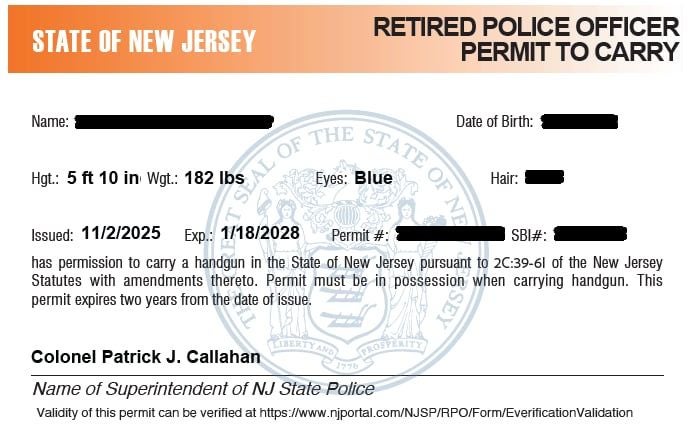
The New Jersey State Police are facing a lawsuit after stonewalling an OPRA request for demographic data on retired law enforcement officer carry permits — data the agency already makes publicly available for civilian permit holders.
Freelance journalist and Bearing Arms contributor John Petrolino, represented by West Berlin attorney Donald M. Doherty, Jr., filed a verified complaint in Mercer County Superior Court on February 27, 2026, seeking to compel the NJSP to release records related to its Retired Police Officer (RPO) handgun carry permit program.
The complaint, filed under the Open Public Records Act, the common law right of access, and the New Jersey Civil Rights Act, names the New Jersey State Police and an anonymous records custodian dubbed “Trooper X” as defendants.
New Jersey’s Permit Dashboard
As readers may recall from December 2025 coverage, Petrolino had been attempting to get a clearer picture of New Jersey’s total permit-to-carry landscape. The state’s publicly available Permit to Carry Dashboard, maintained by the Attorney General’s Office, tracks civilian permit applications and approvals — but conspicuously excludes retired police officers, who operate under a separate statutory framework under N.J. 2C:39-6. As reported in January, attempts to get even basic accounting figures from the NJSP had already been batted back.
What the Records Request Actually Asked For
The OPRA request at the heart of this lawsuit, filed on January 27, 2026, was considerably more targeted than simply requesting permit numbers. Petrolino sought copies of the RPO initial application forms from 2024 and 2025, and renewal applications from 2024 through the date of response — but volunteered to accept heavily redacted versions containing nothing more than county of residence, sex, race, yes/no answers to the application’s disqualifier questions, and the final determination of approved, disapproved, or granted on appeal.
He even offered to accept a spreadsheet summary in lieu of the actual forms. His common law interest was stated plainly in the request: he is a credentialed journalist who covers Second Amendment issues.
The Denial and the Non-Answer That Followed
The NJSP denied the request on February 5, citing N.J.A.C. 13:54-1.15, a regulation that limits the release of firearms permit information to government actors operating in official capacities. The denial was issued by the anonymous Open Public Records Unit with no individual signature, which itself forms the basis of a separate count in the complaint — OPRA requires custodians to sign and date denial forms, and the law anticipates an identifiable human being who can be held accountable.
Petrolino followed up by email on February 12, noting that while the regulation may well apply under OPRA, it does nothing to address his invocation of the common law right of access, and asking the NJSP to explain what state interest justified withholding purely demographic data with no personal identifiers attached.
The NJSP’s February 13 response acknowledged the common law claim and stated that a balancing of interests had been conducted, but articulated no actual interest on the state’s part beyond a general assertion that confidentiality of firearms permitting records outweighs the public interest in disclosure.
Why the Lawsuit Argues the State Has No Leg to Stand On
The complaint argues that this non-answer is evidence that no real balancing test took place at all. The brief supporting the Order to Show Cause walks through each of the six factors established in Loigman v. Kimmelman, 102 N.J. 98 (1986), finding that every single one favors disclosure.
Releasing anonymized demographic data — the same categories the state already publishes about civilian permit holders — cannot discourage anyone from applying, cannot identify any individual, has no bearing on agency self-evaluation, involves purely factual data rather than policy deliberations, and has nothing to do with any pending disciplinary proceedings.
The complaint also notes that the New Jersey Supreme Court previously addressed records nearly identical to these in Southern N.J. Newspapers, Inc. v. Township of Mt. Laurel, 141 N.J. 56 (1995), finding that N.J.A.C. 13:54-1.15 did not foreclose disclosure under the common law right of access — and in that case, the newspaper was seeking full disclosure rather than the extensively pre-redacted records Petrolino has already agreed to accept.
Who Is ‘Trooper X’?
Beyond the records dispute, the suit raises a structural problem with how the NJSP handles OPRA. The agency does not identify a records custodian by name anywhere on its website or its OPRA forms. Responses are issued by the generic “Open Public Records Unit (NS)” with no individual signature.
OPRA explicitly requires a named, identifiable custodian — someone who can sign forms, be held to penalties for violations, and be subject to the kind of discipline the statute contemplates. The complaint asks the court to order the NJSP to designate and publicly identify a specific individual as its records custodian, in addition to compelling production of the records.
The Civil Rights Angle
The three-count complaint proceeds under OPRA and the common law right of access (Count 1 addressing the custodian problem, Count 2 addressing the merits of the records request), and the New Jersey Civil Rights Act (Count 3), which provides for injunctive relief and attorney’s fees when a government actor deprives someone of a substantive right secured by the laws or Constitution of New Jersey.
The brief argues at length that the common law right of access qualifies as such a right, tracing it from English common law through New Jersey’s colonial history, Ferry v. Williams (1879), and the continuity clause of the 1947 State Constitution.
Why This Data Matters
The underlying journalistic purpose here is straightforward, and the public interest is real. Petrolino’s prior reporting on New Jersey’s civilian carry permit data revealed, among other things, that Black applicants were being denied permits at rates dramatically higher than white applicants — a disparity that, to date, the state has declined to address in any meaningful way.
Whether that same pattern holds in the RPO program, whether applicants with domestic violence histories or criminal backgrounds are succeeding or failing at rates different from their civilian counterparts, and whether the RPO approval process is operating consistently across counties — none of that can be known without the data the NJSP is sitting on.
The state publishes demographic breakdowns for one class of carry permit holders. There is no principled reason to refuse the same categories of information to another. The lawsuit is now before The Honorable Robert T. Lougy, A.J.S.C., in Mercer County.
This is a developing story and will be updated as proceedings advance.