

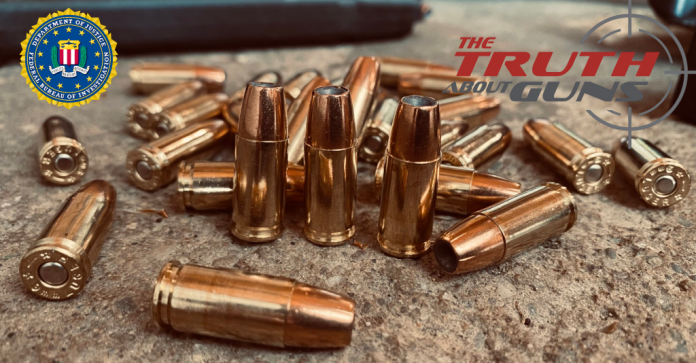
Source: HOP Munitions
The Bureau’s ammunition selection tells us far more about modern projectile science than it does about caliber wars.
The FBI is widely reported to be issuing Hornady Critical Duty 9mm +P 135gr (FlexLock/FTX) as its current duty load. But if you stop there, you’re missing the point of the article.
A recent deep-dive by HOP Munitions, along with a TFB video interview with a 23-year FBI veteran filmed inside the Bureau’s Ballistic Research Facility (BRF), lays out exactly why the FBI made the choices it did — and what that means for anyone serious about defensive ammunition selection.
The Miami Shootout Changed Everything
Before April 11, 1986, FBI ammunition selection wasn’t driven by the kind of laboratory-grade, repeatable wound ballistics standards we see today.
The Miami firefight, a prolonged, violent engagement that left two agents dead and five wounded, exposed a hard truth: the problem wasn’t caliber, it was projectile performance. Specifically, the bullet in use that day failed to reliably penetrate intermediate barriers and still reach vital organs.
The FBI responded by convening a wound ballistics symposium in 1987 and building the rigorous testing protocol that shapes duty ammunition evaluation to this day.
The FBI’s Testing Protocol: It’s About Barriers, Not Bare Gel
The FBI’s handgun ammunition protocol tests bullets the way they’ll actually be used — through clothing, steel, drywall, plywood, and auto glass; not just bare ballistic gelatin.
The benchmark that matters is penetration in the 12–18 inch window after passing through those barriers, deep enough to reach vital structures from imperfect angles, without excessive over-penetration. This six-event structure, developed in the early 1990s, is still widely used today.
From 10mm to .40 S&W…and Back to 9mm
The FBI formally adopted 10mm after Miami, but the “system” — gun, ammo, and shooter population — created operational friction. Recoil management and reliability issues across a large fleet pushed the Bureau toward .40 S&W, essentially a shortened 10mm in a more manageable envelope. But as compact .40 platforms replaced full-size guns while running full-power loads, qualification scores and reliability outcomes suffered again.
The return to 9mm wasn’t nostalgia — it was data. By the late 2000s, modern 9mm duty projectiles were delivering performance in FBI protocol testing that was essentially comparable to .40 S&W, while offering less recoil, higher capacity, faster shot strings, and better fleet-wide reliability. As the FBI veteran puts it plainly in the HOP Munitions interview: “The 9mm didn’t fail — our bullet choice failed.”
What to Look For in a 9mm Duty Load
Without endorsing specific brands, the FBI’s own researcher offers practical guidance:
Look for duty-focused projectiles in the 135–147-grain range, engineered for consistent barrier performance. Bonded or mechanically locked bullets — designed to hold together and expand reliably through intermediate barriers — are where modern defensive ammo earns its keep.
Ultra-light 115-grain loads optimized for raw velocity are, in his words, “old news” for duty criteria. Some 124-grain loads can perform well, but often depend on +P velocity to achieve consistent penetration through barriers.
Bottom Line
The FBI’s ammunition decisions aren’t caliber advocacy — they’re the outcome of decades of wound ballistics work, barrier testing, and fleet-level shooter performance data.
The modern 9mm win is about bullet technology catching up to the FBI’s protocol requirements while improving controllability across a broad population of shooters. If you’re making a serious defensive ammunition decision, the framework matters more than the brand name on the box.