

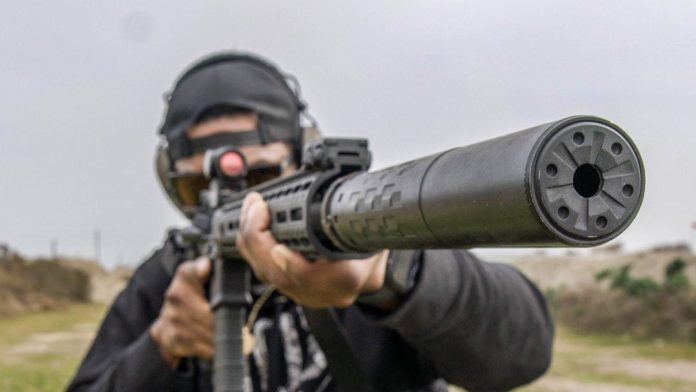
Suppressors work, and that’s why we buy them. They both measurably and audibly cut peak noise from most gunshots down to much safer levels for the unprotected ear and, depending on caliber, barrel length, and ammo choice, can dramatically reduce risk for some setups like rimfire (though most centerfire remains loud enough to warrant caution). While the term “hearing safe” gets thrown around as marketing, in reality, it’s physics and physiology meeting in the middle to make shooting a bit less harmful to your health. The suppressor traps high-pressure combustion gases that would otherwise blast out the muzzle at supersonic speed and ring your bell round after round.
On average, the best suppressors meant for a 5.56 AR-15 on a standard 16-inch barrel measure around 138 dB peak at the ear. 9mm and Rimfire do even better, and I know from firsthand experience that it’s the best you’re going to get from guns and suppressors combined, especially with the right ammo. Optimized .22 LR setups with quality suppressors and dedicated subsonic ammo are typically measured in the low 110s to 120 dB range. Compare that to unsuppressed guns, which routinely push past 160 dB at the muzzle and 140 to 150 dB right at your ear across handguns and rifles.

Now put those numbers against the 140 dB peak impulse benchmark you’ll see in occupational noise standards. 140 dB is the commonly accepted threshold where unprotected ears enter real risk territory for acoustic trauma when it comes to single gunshots. To put it simply, this means that if the noise you’re hearing is at 140 dB or greater, then you are actively doing damage to your hearing.

” Impulsive noise, which includes impact and impulse noise, is a rapid rise in sound pressure that typically lasts less than one second. Impulsive noise is generally more hazardous than continuous noise, and it has a synergistic effect when combined with continuous noise exposure. Some exposures can have peak levels above 170 decibels or dB (e.g., flash-bangs, large caliber firearms, breaching operations).”
-Erin P. Gilmore, Acting Director
Directorate of Enforcement Programs – OSHA
As can be read in the quote from OSHA above, a single unsuppressed centerfire shot definitely surpasses the 140 dB benchmark. In fact, since the decibel scale is logarithmic in nature, unsuppressed gunfire often obliterates that 140 dB threshold. A quick way to put decibel measurements in perspective in your head is to remember that every 10 dB increase or decrease is equivalent to a 10x increase or decrease in energy. If we use a typical measurement for suppressed and unsuppressed 5.56 (~135 and ~165 dB, respectively), the difference between the two is nearly 1,000 times more sound energy being produced by the unsuppressed gun versus the suppressed one – quite the difference. You can also apply this same math to hearing protection to evaluate the Noise Reduction Rating (NRR) of your earpro.

If you’ve ever shot a centerfire firearm unsuppressed or had a similarly loud explosion or noise occur near you, you’ll know that it is often accompanied by a distinct ringing, and sometimes one that won’t ever go away (tinnitus). Suppressors are an easy way, even with regular ammo, to help reduce the risk of hearing damage with unprotected ears. By adding only a suppressor, you’re typically looking at 125 to 140 dB for rifles and pistols at the ear, which is a meaningful drop, absolutely. But for most centerfire stuff, you’re still dancing near that line, especially if you’re magdumping, using an FRT, or have the good fortune of owning a full-auto gun. All that to say that even with a good suppressor, it’s a good idea to wear an extra form of hearing protection, especially if you’re shooting indoors.
It’s not quite the same for rimfire guns with suppressors. Silencer Shop’s quietest suppressor guide shows .22 LR cans regularly hitting 110 to 125 dB at the ear with the right host and subsonic ammo. That’s well under the impulse threshold, but in reality is still pretty loud: in the realm of a jackhammer or passing ambulance than a gunshot. No surprise there: .22 LR starts from a lower pressure baseline, and suppressors can capture nearly every bit of muzzle blast. Those numbers make extended plinking sessions genuinely pleasant without uncomfortable muffs or plugs.

Plenty of variables affect these readings, however. Subsonic ammo alone will cut out the supersonic crack that adds 10 to 15 dB all by itself. Longer barrels burn more powder completely, reducing unburnt residue noise, which is why SBRs are still pretty loud even when suppressed. Gas guns like ARs throw port pop out of the receiver that no suppressor can fully tame, and special BCGs only sort of help mitigate. Silencer Shop’s own content throughout the years hammers this home by basically saying that bigger volume and length generally mean better suppression because you’ve got more space to slow those gases down.
While they used to be somewhat of a curiosity or a major NFA flex, these days suppressors are more than commonplace. This new mass-adoption of suppressors has also meant that people in general now treat suppressors as serious hearing protection gear that belongs on every rifle and pistol, in addition to pairing them with ear pro for maximum hearing safety. It’s only logical since we’ve now got a lot of data to back most of the claims that suppressor manufacturers make these days.

The bottom line when it comes down to the raw numbers at the meter is that suppressors transform the shooting experience. That 20-35 dB haircut on peak impulse noise cuts temporary ringing, preserves situational awareness after strings, and meaningfully lowers the concussion from the shot, as well as your long-term odds of tinnitus or complete hearing loss. Centerfire shooters get the biggest relative win, going from eardrum-shattering to merely loud, and rimfire junkies like me get bragging rights about “quiet range days” that are genuinely reflective of the name. Either way, the numbers don’t lie. Cans earn their place in the safe as legit safety devices when it comes to your hearing, even if it is simply another layer there to help protect the only set of ears you’ve got.
