

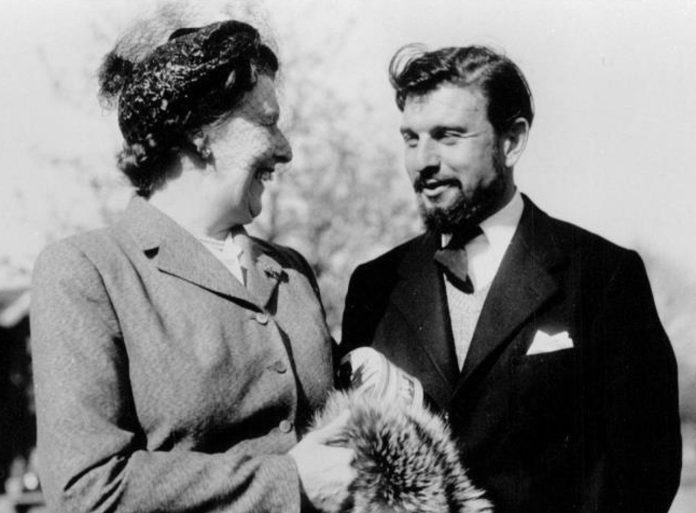
In the long, labyrinthine history of espionage, few figures loom as darkly, or as enigmatically, as George Blake. To some in Moscow, he died a hero in 2020, a loyal servant of the socialist cause. To Britain, he remains one of the most devastating traitors ever to infiltrate its intelligence services. His story is not simply one of betrayal, but of ideology, identity, and the strange moral universe inhabited by spies.
Britain’s Secret Intelligence Service (SIS), commonly known as MI6, would later become the stage on which Blake carried out one of the most damaging betrayals in British espionage history. Blake’s life reads like a Cold War thriller, yet the truth is more unsettling than fiction. Born George Behar in Rotterdam in 1922 to a Dutch mother and a Sephardic Jewish father, he grew up between cultures, languages, and loyalties. This fluid identity would later make him both an ideal recruit for MI6 and a perfect target for Soviet intelligence.
George Blake’s Path to Espionage
When the Second World War began, George Blake—then still George Behar—escaped Nazi‑occupied Netherlands and eventually reached Britain. Once there, he joined the Royal Navy and was soon recruited into the Secret Intelligence Service (SIS) commonly known as MI6. During this period, he adopted the surname Blake, a step that reflected his integration into British life, though not necessarily a dramatic renunciation of his past.
In 1948, MI6 posted him to the British diplomatic mission in Seoul under diplomatic cover as vice‑consul. It was a significant assignment for a young officer, placing him in a region of growing strategic importance. But events soon overtook his career. When North Korean forces captured Seoul in June 1950, Blake was taken prisoner and remained in captivity for nearly three years.
Those years proved decisive. Blake later said that witnessing the devastation caused by American bombing raids on North Korea convinced him that communism represented a more just world order. Whether this was a sincere ideological transformation or a retrospective justification remains debated among historians, but the outcome is clear: during his imprisonment, Blake embraced communist ideology.
Before his release in 1953, he volunteered his services to the Soviet MGB, the intelligence service that would soon become the KGB. By the time he returned to Britain, he was already a committed.

Moscow’s Man in MI6
Returning to Britain, Blake resumed his MI6 career with no one suspecting that he had switched sides. He was soon posted to Berlin, then the epicenter of Cold War espionage. There, he committed one of the most damaging acts of betrayal in British intelligence history: he exposed the existence of Operation Gold, a joint CIA‑MI6 tunnel project designed to tap Soviet communications in East Berlin.
The Soviets, forewarned, allowed the operation to continue for months, feeding the West carefully curated information while protecting their real secrets. Blake’s betrayal didn’t end there. Over nearly a decade, he passed thousands of classified documents to the Soviets and compromised dozens of Western agents operating behind the Iron Curtain. Many of those agents were arrested; some were executed.
His treachery was so extensive that historians still struggle to quantify the damage. One MI6 officer later remarked that Blake alone may have caused more harm than the entire Cambridge Five.
Exposure and the Fall
Blake’s exposure did not come through a brilliant counterintelligence breakthrough but through a defector. In early 1961, a Polish intelligence officer, Michał Goleniewski, provided the CIA and MI6 with information indicating that a high‑level mole was operating inside British intelligence. His clues eventually led investigators to George Blake. MI6 confronted him, and after interrogation, Blake confessed to years of espionage on behalf of the Soviet Union.
His trial was swift and conducted behind closed doors. In May 1961, he received a 42‑year prison sentence—at the time the longest term ever imposed by a British court. The figure was widely interpreted as symbolic: one year for each British agent believed to have been compromised through his actions.
For most traitors, such a sentence would have marked the end of the story. But Blake’s saga was far from finished.
The Great Escape
In 1966, in one of the most audacious prison breaks in British history, Blake escaped from Wormwood Scrubs. The plan was hatched not by Soviet masterminds but by a small group of idealistic anti‑establishment activists who believed his sentence was inhumane. Using a rope ladder and a series of carefully timed maneuvers, Blake scaled the prison wall and vanished into the London night.
From there, he was smuggled across Europe and eventually into East Berlin, where he crossed into the arms of the KGB. His arrival in Moscow was treated as a triumph. He was awarded the Order of Lenin and given a comfortable home, a pension, and a new life.

A Hero in Moscow, a Ghost in Britain
In the Soviet Union, Blake fashioned yet another new life. He lectured at the KGB’s Red Banner Institute, contributed to intelligence training, and wrote memoirs reflecting his unwavering belief in the communist cause. He lived quietly on the outskirts of Moscow with his second wife and their children, enjoying a level of comfort and respect reserved for the USSR’s most valued defectors. To the end of his life, he remained unapologetic, insisting that his actions were driven by moral conviction rather than hostility toward Britain.
For British intelligence, however, Blake became a spectral presence—an enduring reminder of how ideological zeal, personal identity, and institutional blind spots can converge with devastating consequences. His betrayal haunted MI6 for decades, not only because of the damage he inflicted but because he had seemed, for so long, like one of their own.
When Blake died in Moscow in 2020 at the age of 98, Russia’s Foreign Intelligence Service announced his passing with full honors. President Vladimir Putin praised him as a “brilliant professional” and a man of “remarkable courage,” framing him as a hero of the Soviet and Russian intelligence tradition. In Britain, the response was subdued, marked by lingering bitterness and the unresolved discomfort of a wound that had never fully healed.
The Psychology of Betrayal
What ultimately propelled George Blake? Ideology alone rarely accounts for a betrayal of such magnitude. His childhood, shaped by dislocation, cultural ambiguity, and the upheaval of war, left him with a lingering sense of rootlessness. Communism, with its promise of moral clarity and universal fraternity, offered him the coherence and belonging he had long lacked.
Yet Blake was not driven by conviction alone. He was a man who drew energy from secrecy. Espionage did not merely give him a mission; it gave him identity. Operating as a double agent intensified that charge. In later interviews, he described feeling “liberated” once he committed himself to the Soviet cause, as if duplicity finally aligned his inner life with his outward actions.
This blend of ideological fervor and psychological complexity is what makes Blake such a disturbing and strangely compelling figure. He was neither a hired gun nor a coerced pawn. He was a volunteer, a true believer who chose his path with clarity, even when that path led him into treachery.
Legacy of a Double Agent
George Blake’s legacy is a paradox. In Russia, he is remembered as a loyal servant of the socialist cause. In Britain, he is a byword for treachery. In the broader history of espionage, he stands as a reminder that the most dangerous spies are not always those who are coerced or corrupted, but those who believe they are doing the right thing.
His story forces uncomfortable questions: How well do intelligence services understand the motivations of their own officers? How do personal convictions intersect with national loyalty? And how many other Blakes might still be hidden in the shadows?
In the end, Blake’s life was defined by contradictions—British and Soviet, hero and traitor, idealist and deceiver. He lived between worlds, and he betrayed one of them completely. Today, Blake stands as one of the most damaging traitors in the history of Britain and the wider Western intelligence community.