

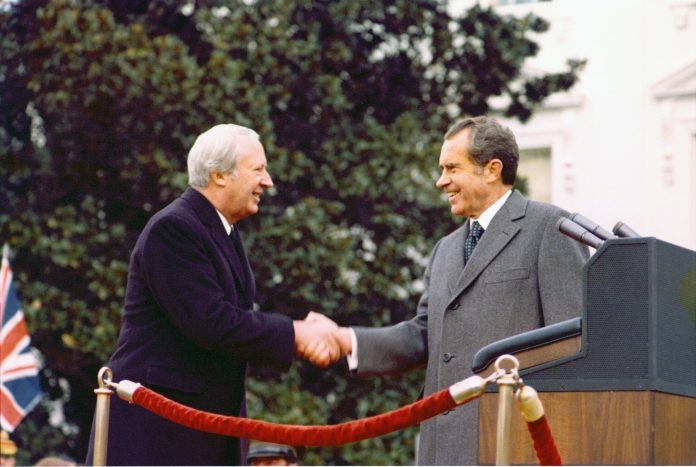
Operation FOOT, launched in September 1971 under the government of Prime Minister Edward Heath, remains one of the most dramatic and consequential counter‑espionage actions of the entire Cold War. It was a moment when the United Kingdom, long a primary target of Soviet intelligence activity, abruptly shifted from a defensive posture to a bold and assertive strategy. By expelling 105 Soviet officials, many of whom the British Security Service (MI5) identified as intelligence officers operating under diplomatic cover, the British government fundamentally disrupted the KGB’s and GRU’s networks in Western Europe. The operation not only reshaped the intelligence landscape in London but also sent a powerful message across NATO and the Warsaw Pact: Britain would no longer tolerate the overwhelming scale of Soviet espionage on its soil.
The Espionage Landscape Before 1971
Throughout the 1960s, the Soviet Union had steadily expanded its intelligence presence in the United Kingdom. London was a prized target: it was a hub of NATO planning, a center of scientific and technological research, and a gateway to Western Europe. Soviet intelligence services, primarily the KGB and the military intelligence agency GRU, took full advantage of diplomatic immunity to embed large numbers of officers within the Soviet Embassy and associated trade missions.
MI5 grew increasingly alarmed. By the end of the decade, MI5 estimated that the number of Soviet intelligence officers in Britain had reached unprecedented levels. Former KGB officer Mikhail Lyubimov later remarked that the Soviet presence in London was so large that it threatened to outnumber MI5’s own counter‑intelligence staff. This imbalance was not accidental. The KGB’s strategy was to saturate the environment with operatives, making comprehensive surveillance impossible and allowing Soviet officers to operate with relative freedom.
Compounding the problem, the UK was still recovering from the shock of earlier espionage scandals, including the exposure of the Cambridge Five. These betrayals had damaged public trust and strained the resources of British counter‑intelligence. By 1970, MI5 was convinced that the Soviet presence had reached a critical point and that only a decisive political intervention could restore balance.
Edward Heath’s Government Takes Action
When Edward Heath, a Conservative, entered 10 Downing Street in June 1970, his government inherited this growing intelligence crisis. Heath’s primary political focus was on economic reform and securing Britain’s entry into the European Economic Community, but the intelligence briefings he received from MI5 made clear that Soviet espionage posed an immediate threat to national security.
MI5 presented the government with detailed evidence of Soviet intelligence activity, including surveillance reports, intercepted communications, and analyses of diplomatic personnel. The conclusion was stark: the Soviet presence had become unmanageable, and incremental measures, such as expelling individual officers, were no longer effective.
After months of internal deliberation, the Heath government approved a sweeping counter‑measure. On 24 September 1971, the Foreign and Commonwealth Office summoned the Soviet ambassador and delivered a formal note declaring 105 Soviet officials persona non grata. They were ordered to leave the United Kingdom within seven days.
The Largest Expulsion in Cold War History
Operation FOOT was unprecedented in both scale and impact. No Western government had ever expelled such a large number of Soviet officials in a single action, and the breadth of the expulsions was striking. Those ordered to leave included diplomats, trade representatives, journalists, and cultural officers—many of whom MI5 had long identified as intelligence operatives working under official cover. The sudden and sweeping nature of the decision caught the Soviet government off guard. Moscow reacted with immediate outrage, accusing Britain of fabricating allegations and acting at the behest of the United States. Despite these protests, the British government remained resolute, insisting that the expulsions were grounded in clear and compelling evidence of hostile intelligence activity.
The consequences of the operation were felt almost immediately. Soviet intelligence networks in Britain were severely disrupted, as many of the expelled officials had been central to running agents, gathering sensitive information, and coordinating covert operations. Their removal created significant gaps in the KGB and GRU’s ability to function effectively within the United Kingdom. The expulsions also placed considerable strain on Soviet diplomatic and trade operations. With so many personnel suddenly removed, the embassy and trade mission were forced to operate with minimal staff, limiting their capacity to conduct both legitimate and covert activities.
Internationally, the operation sent shockwaves through both NATO and the Warsaw Pact. Britain’s allies privately commended the decisiveness of the move, viewing it as a bold assertion of sovereignty and a long‑overdue response to Soviet overreach. In contrast, Eastern Bloc governments expressed anger and disbelief, framing the expulsions as an aggressive and unjustified escalation. Yet the scale of Britain’s action made one point unmistakably clear: the United Kingdom was no longer willing to tolerate the extensive and intrusive Soviet intelligence presence that had taken root over previous decades. Operation FOOT signaled a new era in British counter‑espionage, one defined by firmness, strategic clarity, and a willingness to act decisively when national security was at stake.
Strategic Consequences for Soviet Intelligence
The impact of Operation FOOT on Soviet intelligence operations was profound. For several years after 1971, the KGB and GRU struggled to rebuild their networks in Britain. MI5’s surveillance reports from the mid‑1970s indicate that Soviet intelligence activity dropped sharply, and many remaining officers were forced to operate with extreme caution.
The KGB attempted to compensate by relying more heavily on intelligence officers from allied states such as East Germany, Czechoslovakia, and Cuba. However, these services lacked the deep networks and experience that Soviet officers had cultivated in Britain over decades.
The operation also forced the Soviet Union to reconsider its broader intelligence strategy in Western Europe. The Kremlin recognized that mass expulsions could become a new tool for Western governments, and it began to diversify its intelligence presence across multiple countries to avoid over‑concentration.
A Turning Point in British Counter‑Espionage
Operation FOOT marked a decisive shift in British counter‑intelligence philosophy. For years, MI5 had been constrained by political caution and diplomatic sensitivities. The 1971 expulsions demonstrated that the government was willing to take bold action when necessary.
The operation strengthened MI5’s credibility within Whitehall. It validated the Service’s long‑standing warnings about Soviet activity and demonstrated the effectiveness of coordinated political and intelligence action. In the years that followed, MI5 received increased resources and greater political support, enabling it to modernize its surveillance and analytical capabilities.
Operation FOOT also influenced other Western governments. The United States, Canada, and several European states began to adopt more assertive counter‑intelligence measures, including tighter monitoring of Soviet diplomatic personnel and more frequent expulsions.
Legacy
More than half a century later, Operation FOOT remains a landmark in the history of Cold War intelligence. It stands as the largest single expulsion of intelligence officers ever carried out by a Western government and a rare example of a decisive, large‑scale counter‑espionage action that achieved its strategic objectives.
The operation reshaped the intelligence environment in Britain, disrupted Soviet networks for years, and demonstrated the power of political resolve in the face of covert threats. It also set a precedent for later actions, including the coordinated expulsions of Russian diplomats by Western governments following the 2018 Salisbury poisoning.
Operation FOOT was a strategic strike that altered the balance of intelligence power in the Cold War. Its legacy endures as a reminder that even in the shadowy world of espionage, decisive action can change the course of events.