

We’ve reported in the past about how the Trump Administration has been somewhat wishy-washy on its Second Amendment promises, sometimes siding with gun owners and sometimes supporting arguably unconstitutional gun laws.
Most recently, the Trump Department of Justice (DOJ) has sided with gun owners in a court case challenging the constitutionality of Massachusetts’ handgun roster. On January 26, the DOJ filed an amicus brief with the Boston-based 1st Circuit Court of Appeals in the case Granata v. Healey, siding firmly with the plaintiffs, who argue the handgun roster is unconstitutional.
As background, under the auspices of its approved firearms roster, Massachusetts bans commercial sale and transfer of numerous handguns that are otherwise in common use and widely available for purchase throughout most of the country and which are, consequently, protected “bearable arms” under the Second Amendment. When the U.S. District Court for the District of Massachusetts heard the case, it ruled that the law did not violate citizens’ Second Amendment rights.
The DOJ’s brief argues that although Massachusetts may promote the law as a safety measure, it still violates the Second Amendment.
“Although the Commonwealth characterizes its regime as a set of safety regulations, the effect of the law is to bar ordinary citizens from acquiring widely owned and commonly used arms,” the brief stated. “Under Supreme Court precedent, a State may not accomplish indirectly what it is forbidden to do directly: prohibit arms that fall within the Second Amendment’s core protection.”
As the DOJ further pointed out in the brief, while the lower court recognized Bruen as its standard, it reasoned that the law was constitutional because it did not outright “ban” arms but only set certain safety standards for them.
“The constitutional problem presented here does not require the Court to resolve every question surrounding firearm regulation, commercial licensing or historical analogues,” the DOJ brief stated. “Nor does it require the Court to decide whether States may impose neutral conditions on the sale of firearms in general. This amicus brief addresses a narrower and more fundamental point. Whatever regulatory authority States possess, that authority does not extend to prohibiting the sale of arms that are in common use by law-abiding citizens for lawful purposes. When a law operates to forbid the sale of those arms, it crosses a constitutional line the Second Amendment does not permit.”
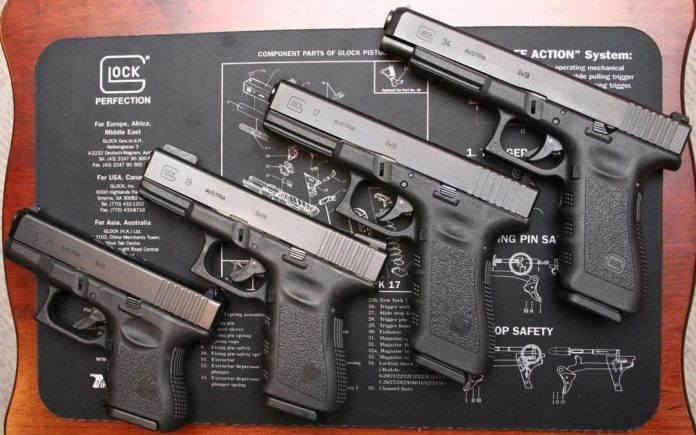
Ultimately, the DOJ explained how simply banning Glock pistols, one of the guns banned by the roster and in very widespread use throughout the nation, defies the constitution. And it backed up its argument with figures showing that Glock pistol production accounts for 7.5 to 8% of all handguns manufactured annually.
Consequently, the DOJ asked the appeals court to overturn the lower court’s decision
“It is thus undeniable that the weapons banned by the Massachusetts scheme are
‘widely legal and bought by many ordinary consumers’ across the Nation,” the DOJ brief concluded. “For this reason alone, the decision should be overturned.”