

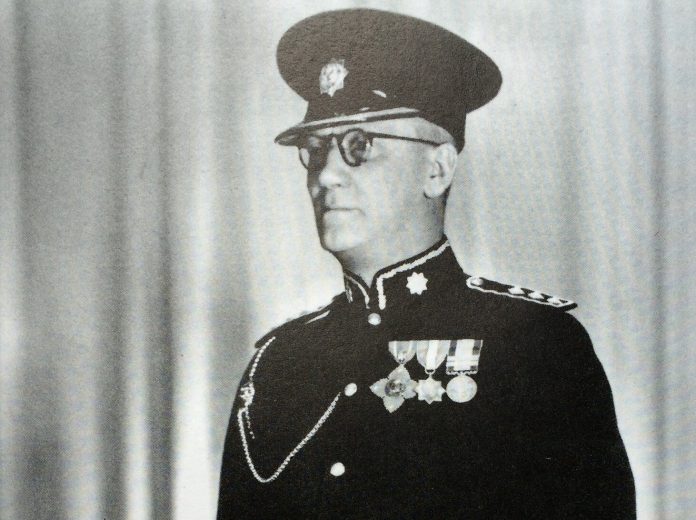
Fairbairn in Shanghai Municipal Police uniform. Unknown photographer. Public domain.
The concept of SWAT teams has become an essential component of law enforcement worldwide, enabling police forces to effectively respond to the most dangerous and complex situations. While the first official SWAT units were established in the 1960s, the origins of this concept can be traced back much further.
Laying the Groundwork
William E. Fairbairn is synonymous with innovation in law enforcement and military tactics. While he is widely recognized for his collaboration with Eric Sykes in designing the iconic “Commando” knife and for his training British and U.S. special operations forces during World War II, Fairbairn’s contributions extend far beyond these achievements. His career in the Shanghai Municipal Police (SMP) spanned over three decades, during which he revolutionized police training and tactics, laying the groundwork for what we now know as modern SWAT teams.
Fairbairn was born on February 28, 1885, in Rickmansworth, Hertfordshire, England. Before joining the SMP, Fairbairn served with the Royal Marine Light Infantry, starting in 1901. His military background provided him with a solid foundation in discipline and combat skills, which later proved invaluable in his police career and his contributions to law enforcement and military tactics.
Shanghai Municipal Police Career
Fairbairn joined the SMP in 1907, starting as a beat constable. Over the years, he worked his way up through the ranks, eventually becoming Assistant Commissioner. His tenure in Shanghai, a city rife with crime and political unrest, provided him with a unique environment to develop and implement advanced policing methods.
Following the May 30th Incident in 1925, where the Shanghai Municipal Police opened fire on protesters, leading to significant unrest and strikes, Fairbairn was tasked with creating a specialized unit to manage riots and armed confrontations. Recognizing the limitations of traditional police tactics, he developed a unit capable of responding to high-risk incidents with precision and efficiency. This vision materialized as the SMP’s “Reserve Unit,” which Fairbairn led for a decade.
Essentially the precursor to the modern SWAT team, the Reserve Unit was designed to handle situations requiring more than the standard police response. Fairbairn’s holistic approach combined rigorous training in formal marksmanship, instinctive practical shooting, close-quarter battle, and hand-to-hand combat. He incorporated techniques from various martial arts, including jiu-jitsu and judo, to ensure his officers were well-rounded and capable of handling any threat.

Fairbairn’s training program was groundbreaking. It emphasized not only physical skills but also mental preparedness and tactical awareness. Officers were trained to shoot accurately under stress, engage in close-quarters combat, and make quick, decisive actions in high-pressure situations. This comprehensive approach to training was unlike anything seen before and set a new standard for police and military units worldwide.
Fairbairn emphasized the importance of cohesive, well-coordinated teams for effective tactical response. He prioritized trust, communication, and mutual support among team members. His training programs fostered camaraderie and unity, ensuring each officer understood their role and responsibilities. Fairbairn encouraged open communication and regular drills to build confidence and reliability in high-pressure situations. By promoting teamwork and collaboration, he ensured the Reserve Unit operated as a seamless, efficient force capable of handling difficult scenarios with precision and effectiveness.
Fairbairn’s innovative approach to training emphasized the importance of realistic, high-stress situations to prepare officers for the unpredictable nature of street combat. Fairbairn is credited with originating the concept of the “shoot house.” He developed a training facility known as the “House of Horrors” for the SMP, designed to simulate real-life combat scenarios and create a highly stressful environment for trainees. This facility was a precursor to the modern shoot houses now used by military and law enforcement agencies worldwide.
Fairbairn’s work in Shanghai had a profound impact. Under his leadership, the Reserve Unit became highly effective in combating violent crime and maintaining order. Fairbairn’s methods enabled them to handle complex situations like hostage rescues, armed confrontations, and riot control, ensuring the city’s safety and security.
Word War II and Beyond
During World War II, Fairbairn was recruited by the British Special Operations Executive (SOE) and was commissioned as a second lieutenant on July 15, 1940. The SOE was a secret British organization tasked with conducting espionage, sabotage, and reconnaissance in occupied Europe. Fairbairn’s extensive experience in combat and policing made him an invaluable asset to the SOE. Throughout the war, he trained British Commandos, SOE operatives, and members of the U.S. Office of Strategic Services (OSS), which was a predecessor to the Central Intelligence Agency (CIA). His training programs emphasized close-quarters combat, unarmed combat, and the use of unconventional weapons, which were crucial for the covert operations these operatives would undertake. By the end of the war, Fairbairn had risen to the rank of Lieutenant Colonel.
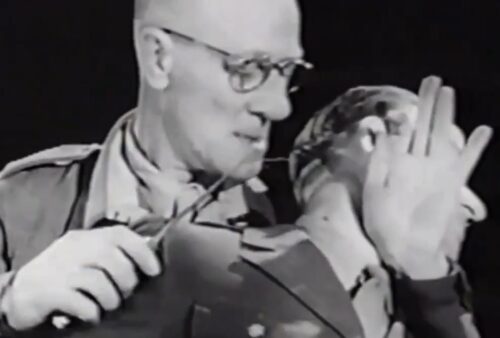
After the war, Fairbairn continued to share his expertise in combat and law enforcement. He worked as a consultant for various police and military organizations, including the Singapore Police Force, where he helped to establish their training programs. Fairbairn’s contributions to tactical training and his innovative methods continued to influence law enforcement and military practices worldwide. His techniques in close-quarters combat, instinctive shooting, and hand-to-hand combat became foundational elements in modern tactical training. Fairbairn’s legacy is evident in the training programs of elite military units and law enforcement agencies around the world. Fairbairn passed away in Worthing, Sussex, England on June 20, 1960, but his impact on tactical training and combat techniques endures to this day.
In Summary
Fairbairn’s pioneering work in law enforcement and military tactics has left an indelible mark on the world. His innovative training methods and creation of the Shanghai Municipal Police Reserve Unit laid the foundation for modern SWAT teams. Emphasizing rigorous training, mental preparedness, and tactical awareness, Fairbairn set a new standard for police and military units worldwide. His legacy continues to influence tactical response units, making him a pivotal figure in law enforcement history. As the father of the modern SWAT team, Fairbairn’s contributions have had a lasting impact. His methods and principles remain integral to police and military training today.